Editor : Martin Simamora, S.IP |Martin Simamora Press
Tampilkan postingan dengan label Berita Internasional. Tampilkan semua postingan

Kamis, 23 Agustus 2018

Election Security: What Can Governments Do Now?

By Dan Lohrman


Protecting the integrity of elections is a hot topic. From cyberattacks to fake news influencing public opinion to other forms of external manipulation that could undermine democracies, voting security has risen to become a top issue for global governments. Here’s what you need to know and potential next steps for the public and private sectors.

  • What really happened with Russia in the U.S. 2016 presidential election?
  • Were any votes changed as a result of hacked voter machines?
  • How did social media and fake news play into influencing voter decisions on candidates?
  • What must be done now to better protect upcoming elections?
These questions, and many similar inquiries, have been asked for the past 15 months, and some important new information has now surfaced to help in formulating judgments and hopefully gain closure. But regardless of pronouncements from leaders on the left, right and center of the political spectrum (who generally see this issue very differently), there is a growing sense of urgency for new actions to be taken regarding protections for future election security.

This election security topic is of paramount importance to our nation. As Juan C. Zarate, chairman and co-founder of the Financial Integrity Network and former deputy national security advisor for combating terrorism, recently wrote: “Fair elections are at the core of every democracy. Russia's actions surrounding the 2016 American election were aimed at undermining the confidence of the democratic process.”

What follows are several excellent recommendations to protect our votes. After framing the top election issues, this blog focuses on actions that governments need to take now.

Senin, 21 September 2015

China Membangun Landasan Pesawat Ketiga Di Kepulauan Laut China Selatan


Previous satellite pictures of construction and dredging under way at Mischief Reef in the Splatly Islands. © Getty Images

China terlihat sedang membangun landasan pesawat ketiga pada  teritori yang sedang diperebutkan di kawasan Laut China Selatan, seorang pakar Amerika Serikat telah mengatakan hal itu  belum lama ini pada Senin 14 September, menanggapi  serangkaian foto satelit yang diambil  seminggu sebelumnya.

Foto-foto tersebut diambil untuk Center for Strategic and International Studies atau CSIS  Washington, yang memperlihatkan pembangunan di Mischief Reef [jadi ini adalah kepulauan batu karang], satu dari sejumlah pulau-pulau buatan China yang telah diciptakan dalam kepulauan Spratly.

Rabu, 23 Oktober 2013

Warren Buffet : Jika Pemerintah AS Gagal Bayar Utang, Itu Adalah Sebuah Ketololan

Oleh :  Martin Simamora


Warren Buffet : Jika Pemerintah AS  Gagal Bayar Utang, Itu Adalah Sebuah Ketololan
Warren Buffett smiles during an interview with Liz Claman of the Fox Business Network, in Omaha, Neb., Monday, May 6, 2013. The Berkshire Hathaway shareholders meeting took place over the weekend. (AP Photo/Nati Harnik) | AP


Bilioner Warren Buffet  mengutarakan bahwa  akan menjadi ketololan bagi pemimpin-pemimpin bangsa mengijinkan Amerika Serikat untuk  membuat gagal bayar utang atas tagihan-tagihannya.

Investor  kondang yang juga  memimpin konglomerat Berkshire Hathaway, menyatakan hal ini pada Rabu, 16 Oktober 2013 di  CNBC, sebagaimana dilansir Huffingtonpost.com

Buffet mengatakan, dia berpikir bahwa pemerintah federal tidak akan gagal membayar tagihan-tagihannya, tetapi 
"if it does happen, it's a pure act of idiocy." -- “jika itu memang terjadi, itu adalah sebuah tindakan murni ketololan.”

Jumat, 18 Oktober 2013

Akankah Terjadi Shutdown lagi? Joe Biden : ”There’s no guarantees of anything”

Oleh : Martin Simamora

Akankah Terjadi Shutdown lagi?

Joe Biden : ”There’s no guarantees of anything”


Telah disepakati oleh Kongres pada Rabu untuk  memperpanjang pengeluaran (anggaran)  pemerintahan Obama hingga  15 Januari 2014 mendatang, dan menaikan batas utang   sampai awal Februari 2014. Tetapi negosiasi-negosiasi  alot telah sedikit melunakkan perbedaan antara Demokrat dan Republik pada pertanyaan pengeluaran pemerintah.

Sehingga akankah bangsa ini  terkena shutdown lainnya? Ada sebuah kasus kuat terkait mengapa itu tidak akan, tetapi prospek kebuntuan fiskal lainnya masih tetap sebuah kemungkinan yang nyata atau jelas.


Shutdown lainnya?

Wakil Presiden Joe Biden menjelaskan hal ini secara jitu pada Kamis saat dia  menyambut para pegawai negeri yang kembali bekerja di Evironmental Protection Agency. ”There’s no guarantees of anything,” atau “Tidak ada  garansi apapun,”  ujarnya seperti dilansir laman nbcnews.com, ketika dia ditanyai apakah dia dapat menjaminkan atau memastikan kembali bahwa tidak akan ada shutdown.

Kamis, 17 Oktober 2013

"Shut down" Berakhir, Pemerintah AS Punya Anggaran Hingga 15 Januari 2014

Oleh Martin Simamora


"Shut down" Berakhir, Pemerintah AS  Punya Anggaran Hingga 15 Januari 2014


Setelah 16 hari  shutting down   dilakukan pada pemerintah Amerika Serikat dan  membawa bangsa ini menuju  ambang gagal bayar hutang/default,  kongres yang menahan anggaran telah melakukan pemungutan suara pada penghujung  Rabu untuk membuka kembali badan-badan federal,  memanggil  ratusan ribu pegawai negeri sipil untuk kembali bekerja  dan menaikan  limit atau ambang batas atas utang $16.7 triliun.


Sebuah kesepakatan diusung oleh Pemimpin Senat Mayoritas, Harry M. Reid( Demokrat- Nevada), dan Pemimpin Senat Minoritas Mitch McConnel (Republik- Kentucky) telah menyudahi sebuah  jalan buntu yang telah terbangun bulan lalu, ketika para konservatif garis keras mendesak para pemimpin GOP (Grand Old Party, ini istilah bagi Republikan) menggunakan ancaman shutdown untuk menjegal  sebuah ekspansi  sangat penting  jaminan kesehatan yang didanai oleh pemerintah  federal, demikian diberitakan laman washingtonpost.com

Selasa, 15 Oktober 2013

Kala Twitter Jadi "Penyelamat" Astronot NASA Saat AS Shutdown

Oleh : Martin Simamora,S.IP

Kala Twitter Jadi "Penyelamat" Astronot NASA Saat AS Shutdown
NASA astronauts Tom Marshburn and Chris Cassidy work outside the International Space Station during a spacewalk in 2009. They were paired again for a rare unplanned spacewalk on May 11, 2013.

Credit : NASA

Astronot-astronot NASA masih dapat mengirimkan tweet dari angkasa luar, meskipun pemerintah AS masih mengalami Shutdown.
Program-program  badan Angkasa Luar semuanya  mengalami penghentian sejak  shutdown  pada pemerintah AS dimulai  1 Oktober, tetapi astronot-astronot; Karen Nyberg dan Mike Hopkins  tetap terus mengirimkan   rangkaian  pemberitaan   pada sosial media International Space Station. Hopkins bahkan telah memposkan   foto-foto awan angkasa luar yang misterius,  dibentuk oleh sebuah  uji coba peluncuran misil Rusia pada 10 Oktober.

Senin, 14 Oktober 2013

Amerika Dalam Bayang-Bayang Kiamat Ekonomi!

Oleh : Martin Simamora,S.IP


Amerika  Dalam Bayang-Bayang Kiamat Ekonomi!

Investors face U.S. default risk with no Plan B-
Credit : reuters.com

Jim Yong Kim,  presiden World Bank telah memberikan peringatan bahwa Amerika Serikat hanya “ sejauh hari-hari dari sebuah momen  yang sangat  berbahaya” karena peminjaman krisis yang dilakukan pemerintah.

Jim, sebagaimana dilansir laman bbc.co.uk, mendesak para pembuat kebijakan untuk mencapai sebuah kesepakatan untuk menaikan  batas atas hutang pemerintah sebelum tenggat waktu Kamis , 17 Oktober mendatang.

Departemen Keuangan Amerika Serikat akan  segera  mengalami kehabisan uang atau dana jika tidak ada kesepakatan dicapai  untuk  meminjam  pada pasar-pasar finansial.


Juga Malapateka Bagi Dunia

Kim telah memperingatkan bahwa  ini dapat menjadi sebuah “ disastrous event” atau “peristiwa yang dapat menimbulkan penderitaan hebat” bagi dunia.

Kamis, 21 Februari 2013

e-Government Di Jerman - Bagian 1


Walaupun   teknologi mengalami  banyak kemajuan, mengantri untuk mengisi bentuk-bentuk dan  menyelesaikan   rencana-rencana  kartu-kartu identitas penduduk dan isu-isu administrasi, hal ini sama sekali bukanlah  sebuah hal  pada masa lalu, Banyak warga Eropa masih menghabiskan waktu berjam-jam untuk mengurus hal-hal semacam ini. Itu sebabnya mengapa konsep e-Government, begitu pentingnya, karena  konsep ini menjanjikan untuk menciptakan efisiensi-efisiensi dan secara signifikan mempersingkat waktu yang dipergunakan oleh masyarakat.

Senin, 04 Februari 2013

Transparansi Internasional : Indeks Korupsi Sektor Pertahanan Indonesia Mencemaskan


Transparansi  Internasional  Inggris belum lama ini telah merilis hasil survei global  terkait indeks korupsi. Dalam survei  tersebut,  Indonesia  diberi nilai E, satu tingkat diatas nilai terendah, dalam GovernmentDefense Anti Corruption Index. Skor ini berarti bahwa Indonesia dikategorikan korupsi dengan “resiko sangat tinggi.”  Hal ini  dipertanyakan oleh Wakil Ketua Komisi I DPR, Ramadhan Pohan terkait validitasnya.

Menurut Ramadhan hasil survei tersebut tak berdasar. “Siapa yang terlibat, dimanakah buktinya? Jika seseorang menuding tanpa menyajikan bukti, itu adalah tindakan tirani,” ujar Ramadhan, seorang legislator dari Partai berkusa, Demokrat.

Senin, 05 Maret 2012

Indonesia Hosts Clean Power Asia To Embrace Cleaner and Renewable Energy

Asian Countries Increase Spend More on Renewable and Clean Power Than Other Developed Nations “Asian countries are overtaking developed ones in terms of spending on renewable and cleaner fossil power projects,” said Daria La Valle, the conference manager of Clean Power Asia. This is clearly illustrated by the 27 case studies of recent and upcoming clean power projects in the Asian region which will be presented at Clean Power Asia 2012 which is taking place in Bali, Indonesia in May. The annual conference and exhibition will gather some 600 leading Asian renewable and cleaner fossil power experts, utilities, energy ministries, regulators, investors and technology and service providers to discuss the latest renewable and cleaner fossil power developments in the region as well as the main challenges that utilities face to adopt greener power sources.

Future of renewable energy in developing world

The future of renewable and clean energy is now in the developing world” says Daria La Valle, “and new government policies have made it more palatable for foreign investors to finance clean power projects here in Asia through various financial instruments and clearer regulatory frameworks.”

The Clean Power Asia conference manager continues: “Indonesia has announced a master plan for the development of renewable energy resources and set a target for renewables to represent 25% of total energy consumption in 2025. Malaysia is hoping that the recently launched National Renewable Energy Policy Plan will help the country hit its targets and the new feed-in-tariffs that recently came into effect will certainly help achieving those targets. Thailand launched its 15-year Renewable Energy Development plan last year and aims to increase renewable energy from 6.4% to 20% in 2022.”

Indonesia the next regional powerhouse

Clean Power Asia’s Daria La Valle says Indonesia in particular has huge potential to be a leading power player in the region: “Indonesia is actually the country with the biggest potential for both renewable as well as cleaner fossil power generation in Southeast Asia. The country sits on the largest geothermal energy resources in the world and has great bioenergy, solar and hydropower potential. Combine this with extensive coal resources and a low electrification rate, and you can see the potential of Indonesia to be the powerhouse of the region.” ===

In addition, she notes, the fall in equipment costs and growing appetite for clean technology has resulted in increased policy support measures and increased investment in cleaner fossil power investments. She adds: “Thailand is involved in clean coal pilot projects, Indonesia is building its first ultra supercritical coal fired power plant. TNB Malaysia has increased its operational efficiency by upgrading 6 existing plants. Successful CO2 sequestration achievements are made and much effort is being made in power plant optimisation and efficiency increase resulting in tremendous CO2 emission reduction results.”

Clean Power Asia’s conference programme will feature more than 80 experts, including:
  • Datuk Loo Took Gee, Secretary General, Ministry of Energy, Green Technology and Water, Malaysia
  • Dr. Songpope Polachan, Director General, Department of Mineral Fuels, Ministry of Energy, Thailand
  • Hatsady Sysoulath, Director General of Institute of Renewable Energy Promotion, Ministry of Energy and Mines, Lao PDR
  • Dr Direk Lavansiri, Chairman, Energy Regulatory Commission, Thailand
  • Dr Kardaya Warnika, Director General of New, Renewable Energy and Energy Conservation Ministry of Energy and Mineral Resources, Indonesia
  • Nu Pamudji, President Director, PT PLN (Persero), Indonesia -Shinta W. Kamdani, Vice Chairwoman in KADIN Indonesia (Indonesian Chamber of Commerce and Industry), Owner and Managing Director of Sintesa Group, and Steering Committee of IBCSD (Indonesian Business Council for Sustainable Development)
  • Y. Bhg. Dato’ Mohd Nazri Shahruddin, VP of Power Generation, Tenaga Nasional Berhad (TNB), Malaysia
  • Yokihiro Hirabayashi, Department Deputy Director, International Business Development Dept., J-POWER, Japan
  • Dr. Nattakit Parkpoom, Specialist System Power Planning, Generation Division, EGAT, Thailand -Heru Dewanto, Commissioner, PT Cirebon Electric Power, Indonesia
  • Anupam Datta, General Manager, Calcutta Electric Supply Corporation (CESC Ltd), India

Event dates and location:

14 - 16 May 2012
Bali International Convention Centre, Bali,
Indonesia

Selasa, 20 Desember 2011

The global economic outlook for 2012 isn't pretty


A eurozone recession is certain, the UK is double-dipping and the US is growing at a snail's pace – fasten your seatbelts, it's going to be a bumpy year 
The economic outlook for 2012: China's growth model is flawed. Photograph: Reuters

The outlook for the global economy in 2012 is clear, but it isn't pretty: recession in Europe, anaemic growth at best in the United States, and a sharp slowdown in China and in most emerging-market economies. Asian economies are exposed to China. Latin America is exposed to lower commodity prices (as both China and the advanced economies slow). Central and Eastern Europe are exposed to the eurozone. And turmoil in the Middle East is causing serious economic risks – both there and elsewhere – as geopolitical risk remains high and thus high oil prices will constrain global growth.
  
At this point, a eurozone recession is certain. While its depth and length cannot be predicted, a continued credit crunch, sovereign-debt problems, lack of competitiveness, and fiscal austerity imply a serious downturn. The US – growing at a snail's pace since 2010 – faces considerable downside risks from the eurozone crisis. 

It must also contend with significant fiscal drag, ongoing deleveraging in the household sector (amid weak job creation, stagnant incomes, and persistent downward pressure on real estate and financial wealth), rising inequality, and political gridlock. 

Elsewhere among the major advanced economies, the United Kingdom is double dipping, as front-loaded fiscal consolidation and eurozone exposure undermine growth. In Japan, the post-earthquake recovery will fizzle out as weak governments fail to implement structural reforms. Meanwhile, flaws in China's growth model are becoming obvious. 

Falling property prices are starting a chain reaction that will have a negative effect on developers, investment, and government revenue. The construction boom is starting to stall, just as net exports have become a drag on growth, owing to weakening US and especially eurozone demand. Having sought to cool the property market by reining in runaway prices, Chinese leaders will be hard put to restart growth. 

They are not alone. On the policy side, the US, Europe, and Japan, too, have been postponing the serious economic, fiscal, and financial reforms that are needed to restore sustainable and balanced growth. Private- and public-sector deleveraging in the advanced economies has barely begun, with balance sheets of households, banks and financial institutions, and local and central governments still strained. Only the high-grade corporate sector has improved. 

But, with so many persistent tail risks and global uncertainties weighing on final demand, and with excess capacity remaining high, owing to past over-investment in real estate in many countries and China's surge in manufacturing investment in recent years, these companies' capital spending and hiring have remained muted. 

Rising inequality – owing partly to job-slashing corporate restructuring – is reducing aggregate demand further, because households, poorer individuals, and labour-income earners have a higher marginal propensity to spend than corporations, richer households, and capital-income earners. Moreover, as inequality fuels popular protest around the world, social and political instability could pose an additional risk to economic performance. At the same time, key current-account imbalances – between the US and China (and other emerging-market economies), and within the eurozone between the core and the periphery – remain large. Orderly adjustment requires lower domestic demand in over-spending countries with large current-account deficits and lower trade surpluses in over-saving countries via nominal and real currency appreciation. 

To maintain growth, over-spending countries need nominal and real depreciation to improve trade balances, while surplus countries need to boost domestic demand, especially consumption. But this adjustment of relative prices via currency movements is stalled, because surplus countries are resisting exchange-rate appreciation in favour of imposing recessionary deflation on deficit countries. 

The ensuing currency battles are being fought on several fronts: foreign-exchange intervention, quantitative easing, and capital controls on inflows. And, with global growth weakening further in 2012, those battles could escalate into trade wars. Finally, policymakers are running out of options. Currency devaluation is a zero-sum game, because not all countries can depreciate and improve net exports at the same time. 

Monetary policy will be eased as inflation becomes a non-issue in advanced economies (and a lesser issue in emerging markets). But monetary policy is increasingly ineffective in advanced economies, where the problems stem from insolvency – and thus creditworthiness – rather than liquidity. Meanwhile, fiscal policy is constrained by the rise of deficits and debts, bond vigilantes, and new fiscal rules in Europe. Backstopping and bailing out financial institutions is politically unpopular, while near-insolvent governments don't have the money to do so. 

And, politically, the promise of the G-20 has given way to the reality of the G-0: weak governments find it increasingly difficult to implement international policy coordination, as the world views, goals, and interests of advanced economies and emerging markets come into conflict. As a result, dealing with stock imbalances – the large debts of households, financial institutions, and governments – by papering over solvency problems with financing and liquidity may eventually give way to painful and possibly disorderly restructurings. 

Likewise, addressing weak competitiveness and current-account imbalances requires currency adjustments that may eventually lead some members to exit the eurozone. Restoring robust growth is difficult enough without the ever-present spectre of deleveraging and a severe shortage of policy ammunition. But that is the challenge that a fragile and unbalanced global economy faces in 2012. To paraphrase Bette Davis in All About Eve, "Fasten your seatbelts, it's going to be a bumpy year!"

 Copyright: Project Syndicate, 2011

Guardian.co.uk

Rabu, 09 November 2011

World’s Worst Countries for Business


As the U.S. and Europe grapple with slowing growth, more businesses are turning attention to emerging markets for expansion and profits. Foreign direct investment (FDI) into countries such as Brazil, Russia, and Indonesia are at record highs, with Brazil attracting $48.4 billion dollars in 2010, an increase of 87 percent over 2009. While it's difficult to resist the growth opportunities provided by emerging markets, running a successful business in many of these countries is far from easy. 
  
We put together a list of the 10 most difficult countries to do business in from 50 of the world's largest economies. Our top 10 rankings are based on the World Bank's "Ease of Doing Business" study, which includes 183 countries. 

The rankings take into account 10 leading indicators, such as the ease of starting a business, getting construction permits, paying taxes, and investor protection laws, to name a few. The 2010 FDI data are from the United Nations Conference on Trade and Development (UNCTAD), while the GDP numbers are from the World Bank. Our list includes some economic superpowers, as well as some minnows. Click ahead to find out which countries are the most difficult to do business in.


10. Argentina

2010 GDP: $388 billion 
2010 FDI: $6.3 billion 

 Argentina is one of three South American nations to make the list of the worst countries to do business in. Out of 10 key indicators for doing business, Argentina has one of the lowest rankings when it comes to acquiring a construction permit. It takes about one year to get a construction permit, compared with an average of about seven months for Latin American countries and the Caribbean. 

Starting a business in Argentina takes 26 days, double the time it takes on average in Organization for Economic Co-Operation and Development (OECD) countries. Argentina defaulted on its debt in 2002, which led to foreign investors fleeing South America's second-biggest economy. Since then, the government has enforced a number of measures to stem money flowing out of the country, such as nationalizing its $24 billion pension fund industry and limiting the purchase of farmland by foreigners. 

 Last week, Cristina Kirchner's government ordered oil and gas companies to repatriate all future export revenue, forcing miners to potentially increase costs stemming from foreign exchange and taxation. The move may make it harder for Argentina to attract foreign direct investment, which the UN estimates fell by 30 percent in the first half of this year. 

9. Russia

2010 GDP: $1.5 trillion 
2010 FDI: $41.2 billion 

Russia may be one of the world's fastest growing economies, but it is also one of the most difficult places to do business in. The country is the toughest place in the world for a business to get an electricity connection, taking nearly nine and half months — almost double the time it takes in the rest of Eastern Europe and Central Asia. 

Russia's upcoming presidential elections have further derailed plans to reform the world's fourth biggest power market. Earlier this year, Prime Minister Vladimir Putin, who is running for president in 2012, said there would be no hike in electricity prices over the first half of next year, a move meant to appease voters ahead of the March elections. 

Russian household electricity bills are among the lowest in Europe and industry experts say prices need to rise to fund reinvestment and growth in the sector. The lack of capital expenditure in the power sector is also stoking fears of a likelihood of more accidents and power outages like Moscow's blackouts last Christmas, which suspended flights and left thousands without power. 

Russia also ranks near the bottom when it comes to cross-border trade. It takes more than three times longer to export something from Russia compared with the average for OECD countries. Trade with Russia may become easier after December, however, when the country is expected to finally become part of the World Trade Organization (WTO), 18 years after first applying to join the 153-member group. Russia is currently the largest economy outside the WTO. 

8. Brazil

2010 GDP: $2.1 trillion 
2010 FDI: $48.4 billion 

Brazil is the world's eighth largest economy, and its GDP growth in 2010 was 7.5 percent, making it attractive for foreign investment. While this economic giant provides a huge opportunity there are also several major hurdles to doing business here. Brazil has one of the highest tax burdens of any major economy, at around 37 percent of GDP.

Firms spend about 2,600 hours a year, equivalent to three and half months, filling tax forms in Brazil. Firms are charged a total tax rate of more than 67 percent, according to the World Bank, which is 20 percent higher than the average for the rest of Latin America and the Caribbean. Another big issue facing businesses in Brazil is getting construction permits. Companies spend nearly 470 days completing 17 procedures to obtain a permit, which is over triple the time it takes on average in OECD countries. 

Brazil is set to host the 2014 FIFA World Cup and the 2016 Olympics. But construction of stadiums and airport terminals for the events has been delayed amid accusations of government corruption. The country's Sports Minister Orlando Silva is under growing pressure to resign after more evidence emerged last month that he allegedly got $23 million in kickbacks for government contracts, for himself and the ruling communist party. 

7. Indonesia

2010 GDP: $706.6 billion 
2010 FDI: $13.3 billion 

Indonesia, Southeast Asia's biggest economy, is one of three Asian countries to make the list of the world's worst places to do business in. The country is one of the most difficult places to start a business. It takes one and half months to launch a business in Indonesia, nearly three and half times longer than the average for all OECD countries.

Getting electricity in the world's fourth most populous nation also takes 20 days longer than in the rest of East Asia and the Pacific. Indonesia's infrastructure problems have long been blamed for hampering its growth. 

Four out of its five busiest international airports are operating above capacity and about 15 million households have no access to electricity. The country wants private investors to provide at least two-thirds of the $150 billion needed for infrastructure development in the next five years.

In July, French firms, including engineering heavyweight Alstom, pledged more than $2.5 billion in energy and infrastructure investments. In the same month, three Chinese companies expressed interest in investing about $3 billion to build ports, toll roads and railway tracks in the main Java island. 

China, the world's biggest energy consumer, is keen to tap into Indonesia's abundant coal and other resources. Earlier this year, Chinese Premier Wen Jiabao pledged $9 billion in loans to support Indonesia's infrastructure development. 

6. India

2010 GDP: $1.73 trillion 
2010 FDI: $24.6 billion 

India, the world's fourth largest economy, has seen quarterly GDP growth of around 7.5 percent over the past decade, but it is also one of the most difficult countries to do business in. Stories of corruption in the government are rampant in India and it is the second worst country in the world when it comes to enforcing a business contract, behind East Timor.

It takes on average of nearly four years to enforce a contract through India's courts, in comparison to three years in the rest of South Asia and more than one year on average in OECD countries. It also ranks among the bottom three globally when it comes to dealing with construction permits, taking more than seven and half months to get one. 

Recently, there have been growing protests from India's urban middle class against endemic political corruption and bureaucracy. Recent government scandals — including a bribery scheme involving the sale of telecom spectrum that may have cost the state up to $39 billion in revenues — has heightened the public's growing discontent with politicians. 

Despite its unfriendly business environment, UNCTAD forecasts India, home to the world's second biggest population, will be among the top five attractive destinations for international investors over 2010-12. 

5. Nigeria

2010 GDP: $194 billion 
2010 FDI: $6.1 billion 

Nigeria is Africa's largest oil producer, therefore a big draw for some of the world's biggest energy and resources companies. Political unrest and growing ethnic and religious tensions make the country one of the worst places to do business in, however. 

Nigeria ranks among the lowest in the world when it comes to getting electricity and registering property for business. It takes nearly three months to get through the 13 procedures required to register a property, compared to one month in OECD countries. The oil trade has also fueled violence and corruption in the Niger delta, where energy giants, including Royal Dutch Shell, have been forced to shut down production often due to a surge in oil thefts. Despite being an oil-rich country, the majority of its population live on less than $2 a day and are exposed to dangerous levels of pollution. 

Nigeria's political instability reached a head last year, when its then-president Umaru Musa Yar'Adua left the country for medical treatment without transferring power, creating a leaderless state for two and half months before an acting president was reinstated. 

4. Philippines

2010 GDP: $199.6 billion 
2010 FDI: $1.7 billion 

The Philippines is the lowest ranked Asian country on the list of the most difficult places to do business in. It attracted just 2.5 percent of the $76.5 billion of foreign direct investment that flowed to the 10 members of the Association of South East Asian Nations (ASEAN) in 2010.

Despite having massive untapped mineral wealth, a key geographical location between Southeast and North Asia and a large, growing English-speaking population, the country has fallen behind its neighbors in economic growth. 

Foreign businesses are wary of the Philippine's unstable legal system, violence, and bureaucracy. Its ease of doing business ranking from the World Bank fell a further two spots this year from 2010. 

The country also ranks among the lowest when it comes to starting a business, and resolving insolvency, with the latter taking more than five and half years, compared with an average one year and seven months in OECD countries. Last month, Philippine President Benigno Aquino made trips to the U.S., China, and Japan to push for investments, as well as to send a message that things are changing in the country, after two previous administrations were dogged by corruption allegations. Aquino's trip to China resulted in $7 billion to $9 billion of potential investments. 

The Philippines also jumped 10 places to 75th in the World Economic Forum's global competitiveness index this year. 

3. Algeria

2010 GDP: $159.4 billion 
2010 FDI: $2.3 billion 

Algeria is one of five oil-rich nations to make the list of the 10 most difficult countries to do business in. Its economy is heavily reliant on the hydrocarbon sector as one of the biggest suppliers of natural gas to the European Union. 

Algeria ranks among the lowest in the world when it comes to starting a business, getting electricity, registering property, and filing taxes. It takes 48 days to register a property in Algeria, compared with about a month in the average of OECD countries. 

Getting an electricity connection takes more than five months, compared with two and half months in the rest of North Africa and the Middle East. The recent political unrest across the Arab world has had a positive impact on Algeria's social and political landscape, however, with the government being prompted to go on a spending spree. 

This has resulted in public sector wage increases, generous food subsidies, and handouts to the unemployed. The International Monetary Fund has also forecast that the Algerian economy will grow 3 percent in 2012. Growth in the long term could be threatened, however, by the fact that gas production from its biggest oil fields has reached a plateau and will soon start to decline. 

2. Ukraine

2010 GDP: $137.9 billion 
2010 FDI: $6.5 billion 

Ukraine is Europe's second largest country and one of two Eastern European nations to make the list of the worst places to do business in. Since gaining independence from the Soviet Union in 1991, the country has been caught between seeking closer integration with Western Europe and reconciling with Russia, which provides for most of Ukraine's energy needs. 

The country ranks among the very bottom when it comes to ease of paying taxes, dealing with construction permits, and access to electricity, to name a few. It takes 27 days for businesses to pay taxes in Ukraine, with the total tax rate at more than 57 percent of a company's profit.

The amount of time it takes to pay taxes is more than double the time in Eastern Europe and Central Asia. Getting a construction permit also requires more than double the number of days than it does on average in OECD countries. Ukraine is not new to political unrest. In 2004, after an allegedly rigged election, Viktor Yanukovych, who supported reconciliation with Russia, came to power and sparked mass protests, known as the "Orange Revolution." 

After a repeat election, pro-West supporter Viktor Yushchenko was sworn in as president in 2005. Political bickering continues to attract world attention, however. Last month, one of the leaders of the Orange Revolution and former Prime Minister Yulia Tymoshenko was sent to jail for seven years on charges of abuse of power involving a gas deal with Russia in 2009. 

1. Venezuela

2010 GDP: $387.8 billion 
2010 FDI: -$1.4 billion 

Out the world's 50 biggest economies, Venezuela ranks as the most difficult place to do business in. The South American nation is among the very bottom when it comes to ease of paying taxes, getting credit, investor protection laws, and cross-border trading, to name a few. Firms spend 864 hours a year paying taxes in Venezuela, more than double the amount of time it takes in the rest of Latin America and the Caribbean. 

The gap is even wider when you compare with OECD countries, where it takes about a fourth of the time to file taxes. Despite having some of the world's largest oil and natural gas reserves, most Venezuelans live in poverty. 

The country's socialist revolution led by President Hugo Chavez has brought about radical reforms, with the major one being the nationalization of much of the economy, especially the oil sector, and strict currency controls. 

All these pose difficulties for private businesses. For example, withdrawing money from your bank account requires not only signatures, but fingerprints and in some cases even a photograph. ATMs have strict daily limits. Identification is even required for the smallest purchases, such as groceries. Inflation is also another major issue in Venezuela. Annual inflation for the 12-month period through September totaled 26.5 percent, showing the country's economy could be getting out of control.



Kamis, 03 November 2011

It's business as usual when it comes to companies paying bribes

The Bribe Payers Index reveals the 'supply side' of corruption, sharing the blame between developed and developing countries Companies from the world's most powerful economies are still thought to routinely pay bribes when doing business abroad, despite a steady stream of new laws and international commitments to stamp out foreign bribery, according to an index that aims to balance the "blame" for corruption between developed and developing countries. Russia and China, which together invested some $120bn overseas in 2010, are ranked the lowest in the latest Bribe Payers Index, published on Wednesday by anti-corruption campaign group Transparency International. Firms from other "emerging economies" – including Mexico and Indonesia – are also among those seen as most likely to bribe abroad.

While many of the world's traditional economic powers continue to suffer from little to no growth, emerging economies have gained mushrooming attention around the world for dramatic growth forecasts and increasing levels of trade and foreign investment – particularly in some of the world's poorest countries. According to the Chinese ministry of commerce, for example, China's investment in Africa increased by 565% over the past seven years.

Wednesday's index, which relies on a global survey of 3,016 business executives, ranks the world's 28 leading export countries on the perceived likelihood that their firms pay bribes overseas. Countries are scored on a scale from 0 to 10: the more a country's companies are thought to engage in bribery abroad, the lower the score. First published in 1999, the index attempts to fill in an otherwise partial picture of global corruption, where a seemingly steady stream of reports of corrupt public officials in developing countries is met by relatively little about those who pay the bribes in the first place. It aims to balance the blame between the bribe-givers and the bribe-takers, and to monitor commitments from the world's richest countries to control what economists call the "supply side" of corruption. In this year's index, the Netherlands and Switzerland earn the highest scores, with Dutch and Swiss companies seen as least likely to bribe abroad. But none of the 28 economies covered by the index is seen to have a wholly clean business sector and there has been no improvement overall since the index was last published in 2008.

Six countries – Argentina, Indonesia, Malaysia, Saudi Arabia, Turkey and the United Arab Emirates – were included in this year's index for the first time and all fall in the bottom half of country rankings. Recent legislation in G20 states has given some campaigners hope that the recent explosion of public interest in corruption might help stamp out foreign bribery – both Russia and China have recently passed laws criminalising foreign bribery by firms headquartered in their countries.
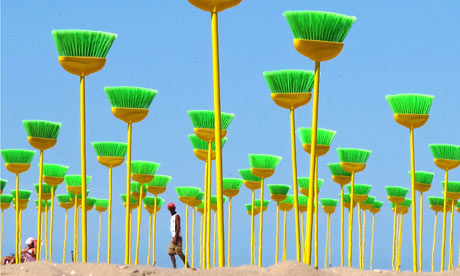
Demonstrators put 600 green brooms on Copacabana beach to protest against corruption in Brazilian politics. Photograph: Rex Features

But eight years after the high-profile adoption of the UN convention against corruption, observers say there has been little real progress. Four G20 countries – Germany, Japan, India and Saudi Arabia – have yet to ratify the UN convention. Little progress has also been made on the older OECD anti-bribery convention: a 2011 progress report found that 21 out of the 38 signatories – including Australia, Brazil, Canada, Mexico, South Africa and Turkey – have rarely, if ever, enforced the convention.


Meanwhile, promises by G20 countries at last year's summit in Seoul, South Korea, to develop an "effective global anti-corruption regime" have been criticised for lacking details and concrete deadlines. The G20 anti-corruption working group is expected to publish the findings of its first monitoring report on Thursday, the start of this year's G20 summit in Cannes. Much like Transparency International's more well-known Corruptions Perceptions Index, Wednesday's report is based on experts' perceptions rather than concrete evidence of bribery.

Hard data on corruption is understandably difficult to come by. Hard evidence about the full impact of bribery on developing countries' economies is largely anecdotal or based on individual case studies. Earlier this year Benjamin Olken from MIT and Rohini Pande from Harvard reviewed the latest academic evidence on corruption and found "more questions to pose than concrete answers". We've pulled out the rankings and country scores for both the 2011 and 2008 editions of the Bribe Payers Index. What can you do with the data?

guardian.co.uk

Kamis, 20 Oktober 2011

Collaborative production of e-Gov services

ePractice is organising a workshop in Brussels on October 27th, focussing on collaborative e-government services: "The notion of collaborative production of eGovernment services refers to the modernisation of the way governments engage and work together with their citizens in developing policies and how these citizens are empowered to harness the opportunities that new technologies have to offer.

The European eGovernment Action Plan, 2011-2015, recognises the significance of this collaboration and stresses the importance of finding the most suitable tools and their best applications.

" The morning session will discuss the achieved benefits and public value created through the joint production of services by public administrations and citizens. The second session, in the afternoon, of the workshop will discuss the interim findings of the study launched by DG INFSO H2.

The study addresses key questions such as:

  • What is collaborative e-government and to what policy areas is it applied? 
  • How are Europe and its Member states positioned? 
  • Does it have a substantial positive impact on the quality of services, while maintaining for universality and accountability?
  • What are the drivers and the barriers?
  • What policy actions should Europe promote, and with which targets?

 In addition this session will complement the discussion by presenting real-life experiences of collaborative e-government from all over Europe. Furthermore, it will discuss potential policy recommendations for the European Commission, as well as for all stakeholders. The discussion will directly feed into the final report of the study. See the provisional program for the afternoon session.

http://epsiplatform.eu

Jumat, 14 Oktober 2011

E-government for a faster, smarter world

The advances that have been made in communications networks, particularly over the past 20 years, have been so rapid and vast that it is difficult to imagine a life unconnected. Sometimes though, we do find ourselves in situations where we don’t have access to communications, and sometimes those occasions are exactly when we need communications the most. It is easy to take communications for granted until the network goes down. At times of extreme peril though, the ability to communicate suddenly takes on absolute importance. If the general population cannot communicate, the situation is bad, but if a government’s communications network goes down, the situation becomes dire.

Crisis is a well worn phrase in the world of corporate communications but in reality the crises under consideration tend to be financial rather than humanitarian. Scenarios of true crisis do not bear thinking about, though responsibility rests with governments to think long and hard about exactly the scenarios for which they must prepare and the solutions they need to have in place in order to care for the people they govern.
Governments need end-to-end security for calls, video monitoring, video conferencing and other integrated services, along with high-speed data transmission, positioning, command and control, emergency response and intelligent data analysis. Governments need to protect against and promptly respond to all kinds of disasters and emergencies, and to help maintain a safe environment for their populations.

This is why events such as ITU Telecom World are important on the communications calendar and why ZTE is so pleased to be involved. Seeing many heads of state and influencers from the public sector mixing with leading innovators from private enterprises demonstrates how vital communications are for world security. We’re a business, of course, and we’re here to help our business grow. So we’ll be making announcements of relevance on the world e-government stage.

But we’re also here to learn from others in both the public and private sectors. Telecom World is a very special event on the technology conference calendar. No other technology event pulls together such a diverse gathering of people and organisations under one roof. Technology and communications might have changed beyond all recognition in the space of just 20 years, but people have not.

The world is not a smaller place, it just seems smaller thanks to technology. I’m sure the next 20 years will bring plenty of surprises, but I predict it will also bring a period of growth and social harmony. Governments will govern, and technology enabling faster, smarter and more efficient communications will result in faster, smarter more efficient societies.

itu.int

Selasa, 11 Oktober 2011

Ernst and Young organises e-government training

As part of its Executive Management Development Programme (EMDP), Ernst and Young recently conducted an E-Government Training Programme for senior Omani government executives. In addition to E-government, the training held at the Muscat Intercontinental Hotel also touched upon topics such as cloud computing, climate change, trends in the oil and gas industry and other subjects.


According to Sridhar Sridharan, Office Managing Partner, Ernst and Young, Muscat: "We are delighted to contribute to the E-Oman Vision through which citizens will have the knowledge, means and tools to interact digitally, access the Internet and use E-services efficiently and safely anywhere and anytime across the Sultanate.
"As an organisation whose strongest asset is our people, we understand that the professional development of skilled and technically competent Omani professionals is a top priority for the Government of Oman. We are happy to contribute to the government in this regard.

" Ernst and Young's Executive Management Development Programme is a year-long training programme designed to develop future leaders in the Omani government. It was launched earlier in the year to celebrate Oman's 40th National Day celebrations.

The programme leverages Ernst and Young's global knowledge and experience to train and develop senior Omani government executives. Senior executives nominated by several ministries and companies owned by the government of Oman will attend at least 10 training modules throughout the year.

Ernst and Young has so far held six training courses for Oman government executives. These include sessions on cloud computing and trends in technology, the global financial crisis, change management, oil and gas, private public partnerships and E-government. Three more training courses will be held before the end of 2011.

Oman's E-government initiative vision is expected to help reduce costs, promote economic development, enhance transparency and accountability, improve services delivery, public administration and facilitate an E-society. E-government is expected to add jobs to the Omani economy and increase Internet literacy among the population to over 60 per cent. The government will be able to achieve higher level of core business continuity through the provision of three times the number of E-services than at present.

An estimated 30 new companies will be incubated to participate in E-government initiatives. "E-Oman embraces the strategy of transforming Oman by empowering its people and will open up thousands of job opportunities for nationals in the IT sector. We are proud of the fact that we are involved in various phases of Oman's development today through our Executive Management Development Programme. We will continue to bring the best global knowledge and practices to Oman," added Sridhar.

.zawya.com

Rabu, 05 Oktober 2011

Kuwait hosts cyber security conference

The Arabian Conference on Information and Communications Security (ACICS) was launched yesterday at the Al-Raya Ballroom under the auspices of the Prime Minister HH Sheikh Nasser Al-Mohammed Al-Sabah. The two-day conference is due to include exhibitions presented by the participating institutions. Speaking at the opening ceremony of the conference, Minister of Information and Communication and Chairman of the Central Agency for Information Technology Salem Al-Othaina announced, "This conference is being held at the time when information and communications security has changed from a technical issue of IT to a national security issue that is addressed with the greatest importance by political leaders.


The United States and European Union have established special departments for information and commun ications security and for countering electronic crimes and terror. Many states envisage having such departments in the future. Offering further details on the Kuwaiti government's plans to guard against electronic crimes, Al-Othaini added, "In Kuwait, the Central Agency for Information Technology, in cooperation with the relevant state institutions, is chiefly responsible for information and communications security systems.


We at the government are looking forward to having this conference increase the capabilities of the Central Agency for Information Technology. The ACICS conference is being held amid the Kuwaiti government's efforts to streamline government services and organization - in effect, to create an e-government that will bring government departments into the 21 Century. Speaking on the subject, Al-Othaini added that, "Modern technology is our way to modern lifestyle in all administrative, educational, health, and economic fields.

We hope that this conference will highlight the necessary steps needed to attain information security from legal, technical a dministrative aspects. CAIT is responsible for the e-government in Kuwait and pursuant to this responsibility it monitors advances made among hackers and perpetrators of other e-crimes.

Director General of CAIT Abdullatif Al-Suraie explained that, "We are making such advances by, for example, drafting the Electronic Dealing Law, which has since been submitted to Parliament to approved. Another important project is executing the Kuwait Information Net, which connects 50 public institutions through one net of fiber optics with the highest level of security and privacy as it uses the modern coding systems and firewalls.


This net offers security and safety for all public institutions dealing in it." Al-Othaina added that, "We at the Ministry of Communications best understand the value and dangers as well as requisite privacy associated with using the networks for information exchange, work, trading and production. In the end we realize that protecting information equals protecting our community and country both today and into the future.

Al-Suraie remarked on the timeliness of the conference, explaining that electronic security and crimes are important and evolving issues globally. "Information and communication technology is the main arena in which to plan, develop and execute economic, social, educational and health plans for rapidly expanding communities today," he explained, noting that, "failure of or damage to these technologies may have unpredictable results.

Al-Suraie also touched the threats inherent in technological advances, explaining, "The technology itself helps develop the techniques of attacking, and this attracts the electronic criminals. Reports issued by specialized international companies in this field show that the electronic pirating has increased this year." In a rapidly-developing technological world, Kuwait is hoping that the ACICS conference will provide experts with a space to exchange ideas and expertise and, in doing so, contribute to grea ter cyber security.

kuwaittimes.net/

EU and Russia complete €2 million e-government project

A €2 million EU-funded project aiming to increase administrative efficiency and improve access to government electronic services for Russian citizens has come to an end, according to a press release from the Delegation of the European Union to Russia. The “Support to e-Government in the Russian Federation – Government-to-citizens electronic services” project ran for 27 months and was designed to support the government’s various initiatives to promote e-Government as a primary instrument in the reform of public administration in the Russian Federation.


It was implemented by the Ministry of Economic Development and the Ministry of Communications and Mass Media in four pilot regions (Kaliningrad, Karelia, Ulyanovsk, Vologda) and three associated regions (Astrakhan, Khanty-Mansiisk and Petropavlovsk-Kamchatsky) and specifically contributed to: improving the relations between government and citizens by strengthening transparency and accountability of the state to its citizens; increasing administrative efficiency; improving access to government services; increasing cooperation within and between Russian regions; establishing a sustainable cooperation on e-Government issues between local and EU partners.


The project built on the results achieved under previous EU-funded projects in the areas of e-Government that were implemented between 2004 and 2009 in Russia. It reached out to 25,000 people, mainly civil servants, covering whole of the Russian Federation. It provided training for 3,000 civil servants from 53 different regions. It has developed 9 e-Government services for the authorities of 6 different regions, holding 56 conferences and roundtables about e-Gov issues across Russia.

enpi-info.eu

Corruption Perceptions Index 2018

Why China is building islands in the South China Sea

INDONESIA NEW CAPITAL CITY

World Economic Forum : Smart Grids Explained

Berita Terbaru


Get Widget