Editor : Martin Simamora, S.IP |Martin Simamora Press
Tampilkan postingan dengan label Financial Industry. Tampilkan semua postingan

Kamis, 16 Februari 2012

Estonia's e-government solution

For several years now the world has lived in the shadow of the recession. Indeed, for some member states of the EU, the financial crisis still looms large, and it is consequently affecting the Eurozone as a whole. However, although the recession hit hard, it also highlighted Europe's ability to react to serious problems in a truly effective way. Faced with often divergent interests and prospects, the governments of the EU have managed to reach agreements on a range of measures that are designed to improve the sustainability of state financing, boost competition and prevent such a crisis taking hold again in the future.

EU member states have managed to agree on mechanisms that ensure the financial stability of the Eurozone and the EU, and the functioning of the single market. Having only acceded to the Eurozone this year, the government of Estonia is frequently asked whether we regret our decision to adopt the euro at a time when we are having to support countries for whose problems we are entirely blameless. The answer I give has always been, and will always be, the same: the euro is of enormous benefit to Estonia in any event, which is why we view our transition to the single currency as such an achievement. At the same time, being part of the Eurozone means that we have to meet all of the obligations that this entails.

It is a question of solidarity, which is one of the cornerstones of the EU. We do not know when we may need the help and support of others; providing it is a moral duty. Moreover, it means that a crisis situation in one member state of the Eurozone is far from being just that country's problem: in a common market, one nation's concerns are shared by everybody.

Of course, we should not forget that every country is still primarily responsible for its own economy and finances, which is why the loans from the support funds are issued on such strict conditions. Measures designed to promote growth will only work once a country has put its finances in order: public services cannot be provided using borrowed money, and doing so is neither sustainable nor morally justifiable. Consequently, this financial support, coupled with decisive action on the part of governments, will ensure the desired results and emergence from the crisis. With hindsight we can see that riding out the recession has been less turbulent for those countries whose governments have managed to avoid excessive growth in public debt and maintain a minimal budget deficit.

According to Eurobarometer, electors also have faith in their governments in countries where the budget deficit and the level of public debt are low – with the greatest support being enjoyed in countries such as Luxembourg, Sweden and Estonia.

In Estonia we did not only keep our revenues and expenditures in balance, but were guided by the principle that its pays to boost your financial reserves when the general economic situation allows you to do so. Although there were recommendations to increase the level of public debt, the Estonian government decided against this and also did not use its reserves for a kind of 'economic doping'. If we had done so, we would not only have to repay loans, but would also be accruing substantial amounts of interest – happily we are now able to invest that money in new economic growth. On average, the EU spends 3% of its GDP every year paying interest on loans; in Estonia, however, we only pay 0.2%, whilst also earning more from the placement of our reserves than we pay in interest overall. Furthermore, Estonia has the lowest public sector debt in the EU, which stands at 6.6% of GDP.

Hopefully we will soon be speaking of the financial crisis in the past tense, enabling us to focus our efforts on the other challenges facing the EU. It seems strange, for instance, that we have yet to fully develop the internal market that forms the basis of our economic growth and wellbeing. For Estonia, the development of the internal market means, first and foremost, its adaptation to the demands of the digital age. Business operators and ordinary citizens alike must be able to carry out processes via electronic channels with other countries as easily as they are able to do so in their own nation. If this does not happen, there is no point to the term 'internal market' in the context of the EU.
Estonia, however, has good reason to be satisfied with the e-services it provides: the e-government solutions that have been developed in our country set the example in terms of their simplicity and transparency. This has had a positive influence on more than just the private sector; Estonian citizens have come to take the likes of the e-Tax and Customs Board and e-elections for granted, not to mention the other services that reduce bureaucracy and make their lives much simpler.

The 'Arab spring', meanwhile, has brought another serious problem to the attention of the EU this year: illegal immigrants and refugees. To some extent this has tested the very principles on which the EU is based: the debates that ignited earlier in the year about reinforcing the Schengen zone included proposals regarding the temporary closure of borders. The reinforcement of the Schengen zone is not about restoring national borders, but restoring trust. Doing so depends on us acting together – it is important that all member states fulfil their obligations on an equal footing and help those having difficulty meeting theirs.

Reinstating national borders is something we can and should only consider under exceptional circumstances. It must be the last resort in a situation where requirements are not being met and there are no signs of improvement. Even then a collective decision would be needed. Understanding and compassion must be shown to refugees, who are seeking security and a sense of certainty; – positive assurances that the EU offers to its own citizens. Over the decades the EU has grown into an area of great stability that no crisis has yet managed to destroy.

The bigger this area of stability is, the better for the EU as a whole. It is for this reason that Estonia is one of the countries that supports, in principle, the continued expansion of the EU, since this will underpin peace and stability in Europe. As such, we must keep our door open to those who share our values and who are willing to work hard to meet the conditions of accession.

.publicservice.co.uk

Jumat, 30 Desember 2011

China racing to expand data center capacity


businessreviewindia.in : data center

China is in the midst of an unprecedented data center construction boom that's providing business opportunities for U.S. companies and could see China emerge with one of the most advanced computing infrastructures in the world. The country is building dozens, maybe hundreds of large data centers to support the needs of its fast-growing online population, estimated now at close to 500 million. The data centers will help to meet escalating demand from telecom providers, and for services such as e-commerce, online banking and e-government
  
They will also provide computing infrastructure for overseas firms looking to expand in China. But the uncertain political and regulatory environment make it unlikely that China can turn itself into a hub for international business in the region, to rival countries such as Hong Kong and Singapore

The build-out is strongly backed by the Chinese government, which has made expanding the national computing infrastructure a part of its latest five-year plan. And local governments are funding the development of vast "cloud cities" -- industrial zones that aim to provide the foundations to support as many as 20 data centers over time. 

The boom is providing opportunities for outside firms such as Hewlett-Packard and IBM. "We have more people in China focused on data center development and strategy than, I believe, in any country in the world," said Rick Einhorn, worldwide director for HP's Critical Facilities Services group.

China is heavily reliant today on outside firms for design expertise, he said, although that could change as HP and other firms work alongside Chinese engineers and provide them with training and experience. The nation's approach to data centers is “to build more and to build big,” said Glen Yuan, executive of data center services for IBM's Greater China group. 

The facilities being built for banks and telecom providers are sometimes vast, covering up to 50,000 square meters (538,000 square feet). China has seen waves of data center construction in the past, but those efforts were often hasty and suffered from poor planning, Einhorn and Yuan both said. Some data centers quickly exhausted their capacity, with the poor infrastructure making services in the country unreliable.

This time around, China hopes to do it right. The Suzhou International Science-Park Data Center (SISDC), in southeastern China, for example, is the country's first Tier 4-certified data center, according to Ivan Lau, a senior sales director with SISDC. 

Tier 4 signifies the highest level of reliability. Built with help from IBM, an initial phase opened for business in October 2010, and the data center will cover 42,000 square meters when a second phase is completed in 2013 or 2014. The Suzhou government is funding construction, with hopes of making the industrial park where it is based a major hub for IT services

About 80 percent of the existing capacity is in use or reserved by customers, Lau said. Many of its biggest customers are foreign financial firms, which are required by Chinese law to store data about its citizens within the country. Government directives on carbon emissions mean data centers are being built using modern, energy-efficient technologies, Einhorn said. 

Some employ modular, multi-tier designs, which help to match power and cooling equipment to the requirements, in turn reducing wasted energy. But while data centers are booming for domestic use, some are skeptical that companies will pick China as a base for providing IT services internationally. 

"There are questions around ownership rights for data and other assets," said IDC analyst Michelle Bailey. "It will be interesting to see if China can evolve its policies to keep in step with the market." A former security consultant who worked on data center projects in China said foreign companies have several causes for concern.
He sees three main areas of risk -- local employees absconding with data, traffic being monitored or interfered with, and the loss of equipment during sudden "inspections" by Chinese police. "The last of these is what sets China apart from most other geographic options," and can result in the government cutting off access to equipment for several days, said the consultant, who asked not to be identified. 

Trying to get outside firms to host their IT infrastructure in China is "an exercise in futility," he said. Lau said those fears are unfounded and may have been fuelled by Google's much-publicized problems in the country. As long as companies follow China's rules and regulations, they will face no problems locating data centers in China, he said. 

There are other challenges too, however, such as securing adequate bandwidth and power. And China needs to keep pace with a population that is adopting PCs, smartphones and tablets at a rapid pace, said Sheldon He, a product marketing manager with Intel. The client-to-server ratio in China is currently more than 60 to 1, he said, while in the U.S. it is closer to 20 to 1. “China has almost five times the population of the U.S., so our problems are five times greater,” He said. “We have the world’s biggest billing systems. If we can succeed in solving these problems it could lead to innovation.” 

COMPUTERWORLD http://news.idg.no

Selasa, 20 Desember 2011

The global economic outlook for 2012 isn't pretty


A eurozone recession is certain, the UK is double-dipping and the US is growing at a snail's pace – fasten your seatbelts, it's going to be a bumpy year 
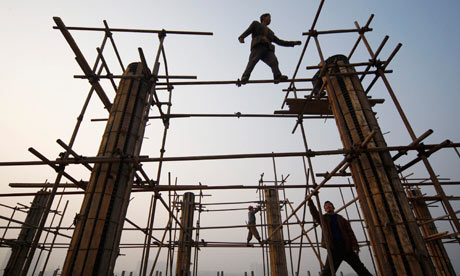
The economic outlook for 2012: China's growth model is flawed. Photograph: Reuters

The outlook for the global economy in 2012 is clear, but it isn't pretty: recession in Europe, anaemic growth at best in the United States, and a sharp slowdown in China and in most emerging-market economies. Asian economies are exposed to China. Latin America is exposed to lower commodity prices (as both China and the advanced economies slow). Central and Eastern Europe are exposed to the eurozone. And turmoil in the Middle East is causing serious economic risks – both there and elsewhere – as geopolitical risk remains high and thus high oil prices will constrain global growth.
  
At this point, a eurozone recession is certain. While its depth and length cannot be predicted, a continued credit crunch, sovereign-debt problems, lack of competitiveness, and fiscal austerity imply a serious downturn. The US – growing at a snail's pace since 2010 – faces considerable downside risks from the eurozone crisis. 

It must also contend with significant fiscal drag, ongoing deleveraging in the household sector (amid weak job creation, stagnant incomes, and persistent downward pressure on real estate and financial wealth), rising inequality, and political gridlock. 

Elsewhere among the major advanced economies, the United Kingdom is double dipping, as front-loaded fiscal consolidation and eurozone exposure undermine growth. In Japan, the post-earthquake recovery will fizzle out as weak governments fail to implement structural reforms. Meanwhile, flaws in China's growth model are becoming obvious. 

Falling property prices are starting a chain reaction that will have a negative effect on developers, investment, and government revenue. The construction boom is starting to stall, just as net exports have become a drag on growth, owing to weakening US and especially eurozone demand. Having sought to cool the property market by reining in runaway prices, Chinese leaders will be hard put to restart growth. 

They are not alone. On the policy side, the US, Europe, and Japan, too, have been postponing the serious economic, fiscal, and financial reforms that are needed to restore sustainable and balanced growth. Private- and public-sector deleveraging in the advanced economies has barely begun, with balance sheets of households, banks and financial institutions, and local and central governments still strained. Only the high-grade corporate sector has improved. 

But, with so many persistent tail risks and global uncertainties weighing on final demand, and with excess capacity remaining high, owing to past over-investment in real estate in many countries and China's surge in manufacturing investment in recent years, these companies' capital spending and hiring have remained muted. 

Rising inequality – owing partly to job-slashing corporate restructuring – is reducing aggregate demand further, because households, poorer individuals, and labour-income earners have a higher marginal propensity to spend than corporations, richer households, and capital-income earners. Moreover, as inequality fuels popular protest around the world, social and political instability could pose an additional risk to economic performance. At the same time, key current-account imbalances – between the US and China (and other emerging-market economies), and within the eurozone between the core and the periphery – remain large. Orderly adjustment requires lower domestic demand in over-spending countries with large current-account deficits and lower trade surpluses in over-saving countries via nominal and real currency appreciation. 

To maintain growth, over-spending countries need nominal and real depreciation to improve trade balances, while surplus countries need to boost domestic demand, especially consumption. But this adjustment of relative prices via currency movements is stalled, because surplus countries are resisting exchange-rate appreciation in favour of imposing recessionary deflation on deficit countries. 

The ensuing currency battles are being fought on several fronts: foreign-exchange intervention, quantitative easing, and capital controls on inflows. And, with global growth weakening further in 2012, those battles could escalate into trade wars. Finally, policymakers are running out of options. Currency devaluation is a zero-sum game, because not all countries can depreciate and improve net exports at the same time. 

Monetary policy will be eased as inflation becomes a non-issue in advanced economies (and a lesser issue in emerging markets). But monetary policy is increasingly ineffective in advanced economies, where the problems stem from insolvency – and thus creditworthiness – rather than liquidity. Meanwhile, fiscal policy is constrained by the rise of deficits and debts, bond vigilantes, and new fiscal rules in Europe. Backstopping and bailing out financial institutions is politically unpopular, while near-insolvent governments don't have the money to do so. 

And, politically, the promise of the G-20 has given way to the reality of the G-0: weak governments find it increasingly difficult to implement international policy coordination, as the world views, goals, and interests of advanced economies and emerging markets come into conflict. As a result, dealing with stock imbalances – the large debts of households, financial institutions, and governments – by papering over solvency problems with financing and liquidity may eventually give way to painful and possibly disorderly restructurings. 

Likewise, addressing weak competitiveness and current-account imbalances requires currency adjustments that may eventually lead some members to exit the eurozone. Restoring robust growth is difficult enough without the ever-present spectre of deleveraging and a severe shortage of policy ammunition. But that is the challenge that a fragile and unbalanced global economy faces in 2012. To paraphrase Bette Davis in All About Eve, "Fasten your seatbelts, it's going to be a bumpy year!"

 Copyright: Project Syndicate, 2011

Guardian.co.uk

Kamis, 01 Desember 2011

Booz Allen Reports Top Ten Cyber Security Trends for Financial Services in 2012


comtrec.com

Booz Allen Hamilton today cited increased cyber threats to senior executives, the impact of organized crime and mobile device security as among the Top 10 Financial Services Cyber Security Trends that will make 2012 a pivotal year for banks and investment firms as they try to stay ahead of the IT security curve. These threats have a trickle-down effect on every part of a financial services organization, with reputational and financial impacts that can be a huge risk to any organization.
  
“These trends highlight the fact that cyber security today is about living with and managing the risk in your network. It’s more than just preventing security violations,” said Bill Wansley, senior vice president at Booz Allen Hamilton.

“Every day, it’s essential that the financial services industry – from small community banks to large Wall Street institutions – know what cyber security threats are on the horizon, and how the cyber and technology industries are meeting these concerns. 

Today’s business environment requires financial institutions to be more creative in meeting the demands of their customers, shareholders, and regulators,” Wansley said. The following list was developed from research by Booz Allen, which has years of experience in financial services consulting for federal, nonprofit and commercial clients:

Top 10 Financial Services Cyber Security Trends for 2012:

(1)The exponential growth of mobile devices drives an exponential growth in security risksEvery new smart phone, tablet or other mobile device, opens another window for a cyber attack, as each creates another vulnerable access point to networks.  
(2)Increased C-suite targeting. Senior executives are no longer invisible online
Firms should assume that hackers already have a complete profile of their executive suite and the junior staff members who have access to them. 
(3)Growing use of social media will contribute to personal cyber threats. A profile or comment on a social media platform – even by the CEO’s son or sister -- can help hackers build an information portfolio that could be used for a future attack.  
(4)Your company is already infected, and you’ll have to learn to live with it – under control. Security should remain a priority, but today’s risks and threats are so widespread that it will become impossible to have complete protection – the focus of cyber security tactics increasingly must be to analyze, detect and expunge threats inside your system. 
(5)Everything physical can be digital. The written notes on a piece of paper, the report binder and even the pictures on the wall can be copied in digital format and gleaned for the tools to allow a hacktivist-type of security violation, and increasingly this will be a problem.  
(6)More firms will use cloud computing. The significant cost savings and efficiencies of cloud computing are compelling companies to migrate to the cloud. A well designed architecture and operational security planning will enable organizations to effectively manage the risks of cloud computing.  
(7)Global systemic risk will include cyber risk. As banks and investment firms continue on the path to globalization, they will become increasingly inter-connected. A security breach at one firm can create negative ripple effects that greatly impact systemic risk in financial markets.  
(8)Zero-day malware (malicious software) and organized attacks will continue to increase. Like a vicious, insidious virus that mutates, the tools of cyber criminals adapt and change constantly, rendering the latest defenses useless. Firms need to be prepared to adapt quickly as well to zero-day malware and the tactics of organized crime and foreign adversaries that are increasingly used today.  
(9)Insider threats are real. The accidental insider breach will continue to be the primary source of compromise for the Advanced Persistent Threat (APT) and other attacks. Organizations need to focus on security awareness training and internal monitoring to detect intentional and accidental insider access.
 
(10)Increased regulatory scrutiny. Recently, the Securities and Exchange Commission introduced guidelines that require companies to report incidents that result, or could possibly result in, cyber theft or a risk of compromised data considered material. 

More information on these trends is available here.

In its 2011 U.S. Cost of a Data Breach, the Ponemon Institute reported that the financial impact of hacks continues to rise, with the cost per compromised record now at $214 (up from $204 in 2009) and the total price tag for each data breach event averaging around $7.2 million. 

In August 2011, hackers were able to steal $2.7 million from 3,400 customers of a major financial institution, which contributed to the $48 billion in identity fraud losses in the United States each year. “As the list of companies victimized by hacking grows, it is clear that no network is completely impenetrable, but there are effective solutions that can help” said Wansley. 

“To thwart these attacks, one must embrace a dynamic defense that embodies the same aggressive, nimble, and methodical approach as our cyber adversaries use against us today. As the daily headlines remind us, cyber security isn’t something on which anyone can declare victory. Cyber security is now a relentless operational risk issue for every organization that develops or delivers value.” 

 fiercefinance.com

Jumat, 04 November 2011

ITU Sets Global Broadband Targets for Countries

The UN ICT agency, the International Telecommunication Union (ITU) has set new global broadband targets for countries to achieve by 2015. According to a press release from the ITU, its Broadband Commission for Digital Development agreed on a set of four new targets it describes as ‘ambitious but achievable’ that countries around the world should strive to meet. It says countries should meet the targets in order to ensure that their populations fully participate in what it calls ‘tomorrow’s emerging knowledge societies’.  
The new targets it says,cover broadband policy, affordability and uptake:

1. Making broadband policy universal. By 2015, all countries should have a national broadband plan or strategy or include broadband in their Universal Access / Service Definitions.

2. Making broadband affordable. By 2015, entry-level broadband services should be made affordable in developing countries through adequate regulation and market forces (for example, amount to less than 5% of average monthly income).

3. Connecting homes to broadband. By 2015, 40% of households in developing countries should have Internet access.

4. Getting people online. By 2015, Internet user penetration should reach 60% worldwide, 50% in developing countries and 15% in Least Developed Countries (LDCs).

Co
mmenting on the targets, Dr Hamadoun Touré, ITU Secretary-General, who serves as co-Vice Chair of the Commission alongside UNESCO Director-General Irina Bokova, siad:“These targets are ambitious but achievable, given the political will and commitment on the part of governments, working in partnership with the private sector.”

The ITU says it will undertake responsibility for measuring each country’s progress towards the targets. It will produce an annual broadband report with rankings of nations worldwide in terms of broadband policy, affordability and uptake, it adds.

It indicates that the Broadband Challenge endorsed by the Commission recognizes communication as ‘a human need and a right’, and calls on governments and private industry to work together to develop the innovative policy frameworks, business models and financing arrangements needed to facilitate growth in access to broadband worldwide.
It also urges governments to avoid limiting market entry and taxing ICT services unnecessarily to enable broadband markets to realize their full growth potential. The ITU encourages governments to promote coordinated international standards for interoperability and to address the availability of adequate radio frequency spectrum.

 “We note the importance of the guiding principles of fair competition for promoting broadband access to all,” it reads. “It is essential to review legislative and regulatory frameworks, many of which are inherited from the last century, to ensure the free and unhindered flow of information in the new virtual, hyper-connected world,” it says. The Challenge, additionally, stresses the need to stimulate content production in local languages and enhance local capacity to benefit from, and contribute to, the digital revolution.

UNPAN Asia & Pacific

Senin, 24 Oktober 2011

MALAYSIA NEEDS A DIGITAL ECONOMY - PM

Malaysia needs a solid push and a clear framework to build a digital economy which will be an important enabler for the country’s transformation, said the country’s Prime Minister Najib Tun Razak.The Prime Minister made the remarks during the launch of the 23rd Multimedia Super Corridor (MSC) Malaysia Implementation Council Meeting in Putrajaya.Razak further said the next wave of economic growth would come from the knowledge-based economy, with digital technologies as a key driver of progress.  
He noted that Malaysia ranked 36th out of 70 countries in the Digital Economy Ranking 2010 by the Economist Intelligence Unit. Razak added that, In Asia, Malaysia ranked sixth in the Global Information Technology Report 2009-2010, released by the World Economic Forum, coming behind Singapore, Hong Kong, Taiwan, South Korea and Japan.

 “The main contributors were a steady improvement in broadband, mobile and internet connectivity, as well as government support,” he added. He also announced earlier this year that Malaysia is in the midst of constructing an innovative digital economy framework as part of the government’s transformation programme.

 The prime minister said he gave his mandate to Multimedia Development Corporation (MDeC) to visualise and drive the Digital Malaysia framework as part of National Transformation Policy. MDeC CEO Badlisham Ghazali told FutureGov in an interview earlier this year that MSC aims at helping the country transform in the modern state by 2020, with the adoption of a knowledge-based society framework.

 Ghazali said the MSC is now on its third phase implementation (2011- 2015) and the core initiatives under this phase include the establishment of two new cybercities each year and completing the Innovative Digital Economy framework by the second half of the year.

.futuregov.asia

Senin, 15 Agustus 2011

Citi Slapped with $500K Fine

FINRA: Citi Should Have Detected Internal Fraud Scheme

The Financial Industry Regulatory Authority has assessed a $500,000 fine against Citigroup for its failure to pick up on an internal fraud event that lasted more than eight years.
FINRA

According to FINRA, Citi's negligence in adequately supervising Tamara Moon, a former sales assistant at a Citi branch in Palo Alto, Calif., resulted in $749,978 being skimmed from the accounts of 22 Citi customers. Moon allegedly falsified account records and performed unauthorized trades that targeted elderly, ill or "otherwise vulnerable" accountholders.

FINRA in August 2009 barred Moon from the securities industry when it launched its investigation. On Tuesday, FINRA said its investigators had determined that Citi failed to detect or investigate a series of so-called red flags that should have alerted the bank to Moon's fraudulent use of customer funds. The red flags included exception reports that highlighted conflicting information in new account applications, as well as customer account records that reflected suspicious funds transfers between unrelated accounts.


FINRA says Citi also failed to implement reasonable systems and controls regarding supervisory review of customer accounts, which enabled Moon to falsify new account applications and other records.

Citi, which did not reveal the name of the former employee, says it is cooperating with authorities to ensure the individual responsible is prosecuted to the fullest extent of the law. "In 2008, upon discovering suspicious activity by a former Smith Barney employee, we immediately notified the authorities, terminated her employment and reimbursed impacted clients," says Citi spokeswoman Elizabeth Fogarty. "Protecting our customers is paramount and fraudulent behavior will not be tolerated."

The fine comes just more than a month after federal authorities involved in a separate internal fraud investigation arrested a former Citi executive for the role he allegedly played in embezzling more than $19 million from the bank and its customers.

On June 26, Gary Foster, who had worked in Citi's treasury finance department, was arrested on charges of bank fraud by the Federal Bureau of Investigation as he returned from a trip to Bangkok. If convicted, he could be sentenced to 30 years in prison. [See Citi Case Exposes Insider Risks.]

Investigators believe that between July 2010 and December 2010, Foster moved $900,000 from Citigroup's interest expense account and $14.4 million from its debt adjustment account into the bank's cash account. From there, in eight separate wire transfers, he allegedly had funds routed to an outside, personal account.

Shirley Inscoe, author of "Insidious: How Trusted Employees Steal Millions and Why It's So hard for Banks to Stop Them," says Citi is not alone. Most banks have done a poor job of keeping up with internal threats. [See Database Security Policies Needed.]
"With the economic downturn, I think many banks have cut back on their internal controls and fraud detection because of very tight budgets," Inscoe says. "Any other bank could have just as easily been victimized."

In May, an internal breach at Bank of America led to the compromise customer accountholder information.

"I have seen and heard that several times over the last two to three years. Banks saying, 'If we had not cut back on this or that, we would have caught this sooner," Inscoe says.

In the Moon case, FINRA says Citi should have detected the suspicious activity involving transfers and disbursements in the accounts. "In one incident, Moon misappropriated nearly $80,000 from an elderly widow's account," FINRA says. "An exception report highlighted two address discrepancies in the customer's account documents where the street address did not correspond to the city and zip code provided for the address, and the telephone prefix did not match the zip code of the address. Moon, who had entered the account information, attempted to explain to Citigroup that the discrepancies arose because the client had moved to Arizona, an explanation that did not seem reasonable."

Julie McNelley, a fraud and financial-services analyst at Aite, says the Citi case is the poster child for why more technologies should be applied to help banks track internal fraud.
"In some cases, Citigroup had the technology in place, and it was human error that is to blame," McNelley says. "In other cases, link analysis could have detected the link between Moon and the account she set up in her father's name," an account to which Moon allegedly transferred $150,000.

"It's not clear from the detail here, but it's likely, based on the description, that the frequency with which Moon was involved in transfers and disbursements was out-of-pattern relative to her peers, and behavior analytics may have been able to flag that anomaly," she adds. "This highlights the need for a comprehensive internal-fraud detection capability. While the $500,000 fine is painful, the reputation damage is much more significant."

bankinfosecurity.com

Jumat, 04 Juni 2010

Rekam Jejak Kemajuan E-Government Korea (bagian 2)


Pada perode ketiga (2008-2012), pemerintah mulai membangun target berikutnya, yaitu mengintegrasikan semua sistem e-Government agar pelayanan publik yang sederhana terwujud. Dimulai pada tahun 2008, pemerintah menjalankan implementasi berbagai proyek yang berfokus pada koneksi dan integrasi yang mendukung penciptaan nilai. Untuk mengintegrasikan layanan publik berorientasi masyarakat dan bisnis, sehingga e-Government terintegrasi.


Implementasi e-Government di Korea telah memasuki tahapan tertinggi yang disebut sebagai "Stage V" yang ditandai dengan keberadaan network, dari sebelumnya di Stage IV yang ditandai dengan kemampuan transaksional berdasarkan Web Measure Idex yang ditetapkan oleh Perserikatan Bangsa-Bangsa.

Pemberdayaan e-Government membuat Korea mampu melakukan berbagai perbaikan yang luar biasa di sejumlah sektor. Melalui Electronic Procurement Service (www.g2b.go.kr) 
semua prosedur procurement ditangani secara online melalui sistem satu jendela (Single Window), sehingga memperbaiki efisiensi dan transparansi dalam pengadaan publik. 

Penggunaan Electronic Procurement Service di semua tahapannya seperti; bidding, pemberian kontrak, penandatanganan kontrak, pengantaran dan pembayaran, dilakukan melalui sistem online, dan dapat dipantau secara real time. Semua perusahaan yang telah teregistrasi dapat berpartisipasi dalam proses tender yang diselenggarakan oleh semua organisasi pemerintah melalui sistem registrasi tunggal pada sistem G2B.

Electronic Customs Clearance Service (portal.customs.go.kr) memperluas penggunaan informasi oleh semua entitas atau lembaga terkait untuk memperbaiki dan menyederhanakan proses dan bisnis logistik ekspor/impor serta pengimplementasian sebuah layanan pemrosesan batch atau pencatatan logistik yang mudah digunakan . Laporan-laporan ekspor/impor ke kantor bea cukai dan aplikasi-aplikasi untuk inspeksi dan karantina bagai organisasi-organisasi yang berwenang terintegrasi sehingga dapat memberikan sebuah layanan yang one-stop-service.

Comprehensive Tax Service (www.hometax.go.kr) memampukan semua pembayar pajak untuk mengurus semua kepentingan pajaknya di rumah melalui sistem online atau di tempat kerja tanpa perlu mendatangi kantor-kantor pajak atau bank. Semua aktivitas pajak termasuk penyimpanan dokumen, tagihan dan pembayaran diproses secara online dan informasi pajak dapat dilacak kapan pun oleh pembayar pajak.

Masyarakat Korea menikmati kemudahan mengurus administrasi melalui Internet Civil Service (www.egov.go.kr), dengan sistem ini masyarakat dapat memanfaatkan berbagai layanan administrasi pemerintah kapan saja, dimana saja melalui internet. Masyarakat dapat menikmati 5.300 layanan administrasi melalui website ini lengkap dengan informasi yang sangat terinci. Website ini menyajikan 720 layanan sipil secara online tanpa perlu melakukan kunjungan ke kantor dan menerima hasilnya melalui layanan pos surat. Masyarakat bahkan dapat membuat sendiri 28 dokumen sipil melalui sistem ini.

Patent Service (www.kiporo.go.kr) memungkinkan masyarakat Korea mengajukan atau mendaftarkan paten melalui aplikasi-aplikasi yang tersaji dan dapat memantau kemajuannya secara online. Semua prosedur aplikasi pembuatan paten, peninjauan dan penilaian termasuk pengajuan keberatan terhadap pendokumenan, dan evaluasi tehnikal dapat diakses oleh publik untuk menggunakan layanan-layanan administrasi paten. Sehingga setiap orang dapat mengecek dan mengelola berbagai informasi dengan efisien. Patent Service juga menyediakan layanan-layanan seperti penerbitan sertifikat paten, verifikasi, termasuk pembayaran komisi.

Corruption Perceptions Index 2018

Why China is building islands in the South China Sea

INDONESIA NEW CAPITAL CITY

World Economic Forum : Smart Grids Explained

Berita Terbaru


Get Widget