Editor : Martin Simamora, S.IP |Martin Simamora Press
Tampilkan postingan dengan label Cloud Computing. Tampilkan semua postingan

Jumat, 20 Januari 2012

Are ‘Cloud Hubs’ the Way of the Future?

greenfudge.org
The pressure of moving government applications into a cloud-computing environment is rapidly building as government agencies look to cut IT costs. According to a new report, the concept of “regional community cloud hubs” among government entities will greatly change the way state and local government procure cloud services.

The report, Best Practices: Regional Community Cloud Hubs — The New “Trickle Down” Effect That’s Boosting State and Local Computing by IDC Government Insights defines regional community cloud hubs as one government agency — most likely at the state level — that could serve as a host facility and offer cloud-computing services to other government agencies (most likely local governments), which can then be shared.
The host facility could then gain revenue by selling the cloud services to other government agencies, which in turn would help the host facility gain revenue to offset their own IT costs, according to the report. If local governments buy the cloud services from the host facility instead of looking for cloud services on their own, the cloud services could be purchased at a lower cost. Shawn McCarthy, an IDC Government Insights research analyst, said the concept of the cloud hub has already started to be used in states like Michigan and Utah and have been deemed successful. “They’re dipping their toe in the water saying, this is the way we want to start offering these things,” McCarthy said.

“The smaller governments seem interested because it allows them to get out of the infrastructure business, which can be very capital intensive and very maintenance intensive, so where we are is a toe over the starting line.”

McCarthy said for Utah’s case, the state began segmenting data storage for local government end users. By offering the data storage, some local governments showed interest in tapping into the available storage space. Eventually the state offered to host a server, which triggered more local governments to want to connect into the “hub.” Local governments are interested in moving systems such as applications used to manage its human resources information to the cloud because updating an existing system may cost more, McCarthy said. As the market for cloud computing evolves, local governments may want to look to see if other entities, particular surrounding ones, have a human resources application both entities can share through the cloud.

But providing the cloud doesn’t have to be the responsibility of the state governments. Through the regional community cloud hubs, vendors can play an important role in providing cloud space. McCarthy said state governments (the host facilities) could make agreements with cloud providers for cloud storage, offer the same services to local governments who want to join the hub, and negotiate costs down.

Because there are different types of private clouds, state governments that act as the hosting facilities could either host the private cloud with or without the use of a cloud vendor, McCarthy said. Although the concept of a regional community cloud hub is not quite a trend yet, McCarthy expects state and local governments to start adopting the practice within the next couple of years.

http://www.govtech.com/e-government/Are-Cloud-Hubs-the-Way-of-the-Future.html

Rabu, 11 Januari 2012

Broadband operators are at risk of becoming dumb–pipe providers

LTE is rapidly gaining momentum in the Middle Eastern region. With new LTE deployments and commercial network launches that took place in Saudi Arabia from Zain Saudi, STC, Mobily, and the UAE from Etisalat, LTE subscriptions will grow at an average annual growth rate of 200 per cent. Global LTE subscriptions are racing ahead of initial expectations. They have already passed 3.7 million in the third quarter of 2011, spanning over 36 worldwide networks. The deployment of FTTH services has been steadily growing and boasting speeds of up to 1Gbps, as in the case of the incumbent operator STC in Saudi Arabia. Also, the take-up of IPTV services is noticeable, with the focus of operators such as the Saudi incumbent on international expansion.
Faster speeds and increasingly affordable broadband access has fostered development of a digital economy, encompassing government services (e-government), e-health, e-education and e-commerce. In Qatar, for instance, strategies and specific initiatives have been launched in the areas of e-commerce, e-government, e-health and e-education.

The regulator has also unveiled plans to develop Qatar as a digital media hub, recognising the current underrepresentation of Arabic content on the Internet and hence the potential for growth. Kuwait has also taken steps to develop a digital economy; national level policies for e-health and e-government have been developed, with a number of services available online. For countries that have been lagging behind in the rollout of broadband services like Lebanon, the market is set to enter a new growth phase centred on mobile data services after the two mobile network operators launched the overdue 3G services in 2011, deploying HSPA+ network infrastructure. DSL speeds have also been increased to a minimum of 1Mbps.

Are broadband networks finally catching up with the technological aspirations of consumers, businesses and public bodies?


Reliable and fast broadband networks are paving the road for a new breed of technological solutions based on the so-called Cloud Computing offers demanded by consumers, businesses and public bodies. Cloud Computing technology is being widely adopted worldwide due to its low cost, scalability, security, etc.
Cloud Computing solutions rely on fast broadband access between the end-user and the cloud in order to provide full functionality and features, in addition to remote management. It is noted that in developed countries, cloud computing is growing fast due to the availability of high-speed and robust broadband connections.

In developing countries, cloud computing is a great tool for development in multiple sectors such as education, industrial, financial and telecommunication; however, these goals cannot be achieved where broadband is not fast, reliable and secure. Yet, we note the landing of several broadband submarine fibre-optic cables in MEA and Africa (e.g. IMEWE, WACS, ACE, etc) promises to bring increased connectivity to the region

Will consumers ever fill their super-fast broadband pipes?


Consumers tend to demand more capacity for cheaper prices. Trends show that they are willing to accept offers for new and innovative services. On the operators’ side, as owners of the super-fast broadband pipes, the challenge is to find those services and market them to the “right” customers.
Network providers and operators have an abundance of customer data that enables them to collect a variety of information on user behaviour. Such information could be utilised in building commercial offers, leading to the marketing of the right products to the right customers and eventually raising the demand for and the consumption of broadband pipes.

Service providers are beginning, rightfully, to shift their focus from being mere voice and Internet-pipe providers to working on the right partnerships with application/content providers, in an attempt to tap the potential revenue associated with new, Internet-based services. This is becoming a necessity for them in order to compete in the market and continue to afford the CAPEX and OPEX expenditures required to keep up with increased demand for network upgrades and faster broadband pipes.

What do you think will prove to be the killer application that creates demand for super-fast broadband?


The definition of ‘super-fast broadband’ varies from one country to the other. In some countries such as the UK, super-fast broadband services should be able to deliver more than is currently possible over existing copper telephone lines (i.e. faster than ADSL2+, which tops out at 24Mbps), whereas in other countries, such as South Korea, the speed is 100Mbps. I am not sure as to what will be considered the killer application.

To some, Internet Protocol Television (IPTV) is gaining momentum as an important application for the next-generation Internet and will provide exciting new revenue opportunities for service providers. Internet Protocol television (IPTV) provides digital television services over Internet Protocol (IP) for residential and business users at a lower cost. These IPTV services include commercial grade multicasting TV, video on demand (VoD), triple play, voice over IP (VoIP), and Web/email access, well beyond traditional cable television services.
IPTV is a convergence of communication, computing, and content, as well as an integration of broadcasting and telecommunication. To others, over-the-top (OTT) video services such as YouTube and Facebook are more popular.

These services refer to video, television and other services provided over the Internet rather than via a service provider’s own dedicated, managed IPTV network. OTT is delivered directly from provider to viewer using an open internet/broadband connection, independently of the viewer’s ISP, without the need for carriage negotiations and without any infrastructure investment on the part of the provider.

What technical challenges lie ahead for the broadband industry?


In developing countries including Lebanon, the main technical challenge for the broadband industry is to cater for advanced backbone and access infrastructures in order to cope with the increasing demand for higher broadband capacities.
Building a robust national and access infrastructure including FTTx requires significant public and private investments. Often public funding and/or subsidies are needed to maintain acceptable Return On Investment (ROI) for the private sector. Moreover, serving rural areas continues to be a challenge.

New solutions are being adopted such as public access femtocells, which are cost effective and easy to integrate, especially for remote areas where the backhaul connection could be provided via DMW or satellite. As mentioned earlier, service providers and operators should tap the application/content business through partnerships and/or acquisitions of existing application/content providers. while benefiting from the operators’ visibility on customer behaviour to create innovative products and services.

How big a challenge does over-the-top video pose to broadband operators and networks?
Broadband service providers and operators are at risk of becoming dumb–pipe providers utilised by so-called over-the-top (OTT) application/content providers such as YouTube, Google, Facebook, etc.

Even though revenues from OTT are small in comparison to those from new IPTV service offerings, they still represent a missed opportunity for service providers. Some suggest that the best approach for operators is to negotiate partnerships with OTT providers.

One way to do that would be to charge for content delivery and guarantee quality of service for certain types of OTT traffic. This could be paid for by either the content provider or by the end-user. However, it remains questionable whether giant OTT providers are willing to enter into such agreements with much smaller service providers.

How can network operator’s best monetise their investments in super-fast broadband networks?
Again, with the rise of application/content providers, network operators may become mere data “pipe” providers, selling only the broadband capacity with no significant ROI. Network operators have many options to avoid such a situation.

The first option is to avoid competition with those providers by delivering an extra layer of value that only they can provide. This layer is based on using data analysis, such as Deep Packet Inspection (DPI), which leads to “customer experience visibility”, resulting in huge opportunities in the advertising world such as targeted ads.

The second option is to leverage the network policy capabilities the network operators have, to deliver an enhanced video streaming service for partners that want to guarantee a certain QoS for their customers.

A revenue sharing model might be used in this case. The last option is to benefit from the synergy created by the partnership with (or the acquisition of) existing application/service providers, allowing the creation of dynamic providers that possess customer visibility and application/content exposure.

How can telecoms regulators further support the MEA region’s burgeoning broadband business?
Governments and telecom operators should promote policies that encourage partnerships, especially in the rollout of services like FTTH. Also, because of the huge cost in the rollout of fibre infrastructure, some governments subsidise investments in fibre infrastructure in the same way they do for other utilities like roads and highways, as is the case in Australia and USA.
In addition, regulators and policy makers may consider transforming existing universal service programs into programs for digital inclusion that support broadband services for all citizens. Policy makers and regulators have several options to provide incentives for the private sector to invest in broadband, such as by adopting enabling policies, simplifying licensing regimes (licensing regulation can be simplified and a unified licensing framework can be introduced with all services unified under a single license or concession), making available more spectrum, reducing regulatory obligations and barriers to broadband build-out and access to broadband networks (e.g. by adopting rules or promoting policies and incentives that encourage infrastructure sharing, particularly involving passive sharing of towers, ducts and other support facilities), and offering tax incentives (reduce taxes on services, devices and equipment which will in turn increase penetration levels and pave the way for increased demand of broadband services).

Policy makers and regulators should also stimulate innovation and the development of applications and services by nurturing the creation and adoption of applications, services and digital content (for instance, the wide diffusion of e-government and e-finance applications and services will considerably raise consumer demand for broadband). Moreover, private investment in research and development (R&D) should be encouraged by all possible means.
It is also essential to protect intellectual property, as this empowers researchers and inventors to lead the way to a smart and innovative digital economy. Innovation can be encouraged through intellectual property regimes that balance monopoly use of inventions with building a rich public domain of intellectual materials.

Regulators and policy makers have a role to play in promoting a first-class training system in all countries to provide creative human resources. It is crucial to facilitate investment in all forms of education, notably in the area of R&D, ICT knowledge transfer and the development of digital applications and content (in particular those related to the local culture).

Sufficient and sustainable funding should be provided to universities, computer labs and other public research institutions, leveraging international partnerships when possible and advantageous.

Dr. Hoballah will be speaking at the Broadband World Forum MEA 2012 event, taking place in Dubai in March 2012.

.telecoms.com

Jumat, 06 Januari 2012

Government Cloud Computing launched


.NetApp, Cisco, VMware, Microsoft and CAT Telecom have joined the government cloud-computing initiative, whereby a new information-technology platform will be designed to pool resources and reduce the government's IT spending. Information and Communications Technology Minister Anudith Nakornthap said at the launch today that the scheme should help reduce the government's IT spending by at least 30 per cent, while ensuring regularly updated technology as well as advancement in electronics-based public services.
 
He noted that each year, government units spent nearly Bt50 billion on hardware and software, but they ended up buying old but pricey technology. Asia-Pacific countries such as Australia have deployed cloud computing to provide services to their citizens. 

Many Thai and foreign private firms in Thailand have also adopted the cloud-computing system, so it is inevitable that government agencies will begin to adopt this technology, he added. He said the use of cloud computing would enhance Thailand's image in terms of technology and boost its competitive edge in terms of public services. 

Under the government cloud-computing platform, computer systems and networks could also be relocated from risky areas to protect electronic data. Much electronic data was damaged during the flood disaster. The Electronic Government Agency will be in charge of a pilot project that will pave the way for national implementation in April. 

The three-month pilot project will encompass 10 government units. The initiative aims to reduce IT spending and energy use as well as promote the e-government concept and public services, Anudith said. The Electronic Government Agency is estimating the cost involved. According to the agency, the government's IT spending last year totalled Bt59.8 billion. Of the total, spending on data centres and the disaster recovery centre topped Bt2.6 billion, excluding the cost of hiring experts and equipment. 

nationmultimedia.com


Senin, 02 Januari 2012

Pemerintah Korea Integrasikan Data Center, Tetapkan Patok Ukur Baru Pada IT E-Government ( Bagian 2 - selesai)


Negara-Negara Berkembang Meniru NCIA
TheWhir : Korea's data center consolidation efforts have resulted in nearly $60 million in cost savings

Dengan pengakuan beskala dunia yang disematkan pada model GIDC disain NCIA, GIDC produksi Korea bangkit menjadi sebuah tolak ukur bagi negara-negara berkembang yang dalam proses pengenalan atau penyebaran sistem-sistem e-Government. Lebih dari 1000 pejabat pemerintah  yang berasal  lebih dari seratus negara telah melakukan kunjungan ke NCIA sejak 2007. Mereka ingin mempelajari lebih mendalam berbagai layanan inovatif e-Government Korea dan pengetahuan operasioanlya yang sangat maju. 


Sebelumnya : Bagian 1
Hampir semua pejabat negara tamu yang datang mengunjungi adalah pejabat dengan posisi-posisi yang tinggi di suatu kementerian yang bertanggungjawab untuk mengembangkan berbagai kebijakan e-Government atau eksekusi kebijakan-kebijakan tersebut di semua badan pemerintah. Beberapada dari pejabat tersebut termasuk Menteri Energi Brunei, Menteri Informasi dan komunikasi Mongolia dan Sekjen Kabinet UAE. 

Mereka sedang mempertimbangkan pembangunan sistem e-Government di negaranya dengan menjadikan GIDC Korea sebagai modelnya dan mempelajari pengetahuan pelaksanaan NCIA dalam manajemen data center. Mereka ingin mengetahui bagaimana NCIA meningkatkan stabilitas dan efisiensi sistem dan membawa berbagai manfaat ekonomi melaui integrasi. Sejumlah perusahan IT Korea telah menyebut NCIA (GIDC) sebagai salah satu komoditas ekspor solusi-solusi e-Government Korea yang menjanjikan sebagaimana yang diperlihatkan sebuah survei oleh sebuah badan pemerintah baru-baru ini. 

Mengekspor Model GIDC

Meningkatnya minat dari negara-negara lain terhadap sistem e-Government adalah sebuah tanda yang positif bagi perusahaan-perusahan IT Korea yang ingin memasuki pasar-pasar luar negeri. NCIA berupaya untuk membagi pengalaman-pengalamannya dengan negara-negara lain yang ingin membangun sebuah sistem e-Government yang matang dengan mengikutsertakan perusahaan -perusahaan lokal. 

Pemerintah Korea telah sukses mengekspor berbagai solusi e-Government senilai USD235 juta untuk area perpajakan, pengadaan barang dan jasa sektor pemerintah dan sistem-sistem Bea Cukai selama tahun 2011. 

Pemerintah Vietnam telah mengajukan pijaman ke EDCF (Economic Development Cooperation Forum) pemerintah Korea untuk membangun GIDC di Hanoi. Indonesia, Filipina dan Kenya juga sedang mempertimbangkan untuk memperkenalkan GIDC berbasiskan moedel Korea di negaranya masing-masing. 

GIDC model Korea diharapkan dapat membangkitkan minat yang luas pada negara-negara lainnya. NCIA berencana untuk menawarkan berbagai konsultasi aspek-aspek pengoperasian dan keamanan yang dilakukan dalam pengembangan GIDC Korea. 

Kebanyakan permintaan kini datang dari negara-negara yang saat ini mengoperasikan data center atau sedang merencanakan untuk membangun proyek-proyek terkait. NCIA berencana untuk mentransfer teknologi dan pengetahuan pelaksanaan dengan penandatanganan berbagai MOU dan melakukan berbagai proyek bersama seperti mengundang insinyur-insinyur asing untuk datang ke Korea dan menyediakan berbagai program Pelatihan Kerja, dan mengadakan berbagai seminar kolaboratif untuk berbagai pengetahuan. 

Berbagai Upaya yang sedang dijalankan untuk Mempromosikan Solusi-Solusi E-Government Korea

NCIA telah membuka fasilitas pamer e-Government Korea pada 30 November 2011. Fasilitas ini akan memfasilitasi pengenalan sistem e-Government Korea kepada semua tamu dari luar negeri. "Drama-drama Korea, Lagu-lagu pop Korea beserta filem-filemnya telah begitu populer di luar negeri. 

Orang menyebutnya sebagai "Gelombang Korea". Dan belakangan ini Sistem e-Government Korea jiga menjadi sebuah ekspor Gelombang Korea yang prospektif. Jumlah pengunjung luar negeri yang ingin belajar sistem e-Government Korea meningkat. 

Itu sebabnya kami memutuskan untuk membuat fasilitas pamer sistem e-Government. Pameran ini menghadirkan 10 best practice dari 1000-an lebih layanan-layanan e-Government seperti pajak, Bea Cukai dan pengadaan. Para tamu juga memiliki sebuah kesempatan untuk merasakan berbagai solusi e-Government. Fasilitas pameran ini dioperasikan melaui kemitraan dengan NCIA, berbagai badan pemerintah terkait, dan berbagai perusahaan swasta yang terlibat dalam pengembangan GDIC. 

Martin Simamora | koreaittimes.com

Sabtu, 31 Desember 2011

Pemerintah Korea Integrasikan Data Center, Tetapkan Patok Ukur Baru Pada IT E-Government (Bagian 1)


Badan negara komputasi dan Informatika Korea Selatan "National Computing & Information Agency-NCIA", telah mulai mewujudkan sebuah ide agar pemerintah menempatkan semua sumber daya IT yang dimiliki semua lembaga pemerintah secara terpusat di satu tempat dan mengelolanya sebagai sumber daya IT yang terintegrasi,hal ini diungkapkan oleh Kim Kyung-sup, presiden NCIA. NCIA menjadi satu-satunya didunia yang berfungsi sebagai Pusat Data Pemerintah Terintegrasi atau GIDC (Government Integrated Data Center). Saat ini, NCIA menjadi rujukan untuk "Tolak Ukur untuk GIDC" dan diakui sebagai salah satu solusi e-Government terbaik di dunia, ujar Dr. Kim. Klaimnya mengenai ini dikuatkan oleh Survey e-Government PBB tahun 2010, dimana Korea menempati peringkat pertama dari 192 negara yang disurvei. Pada tahun 2005 menduduki peringkat ke-5 dan pada tahun 2002 peringkat ke-15. 

"Tidak ada pemerintah lain di dunia ini yang pernah mencoba pekerjaan ini. Pada mulanya, sejumlah orang bersikap skeptis terhadap capaian sukses proyek ini, mengingat berbagai potensi konflik kepentingan diantara berbagai kementerian dan skalanya", ujar Kim .


Menuju Smart E-Government melalui layanan Government Cloud Computing 

Jumlah pengguna telepon cerdas di Korea kita jumlahnya melampaui 20 juta. Berarti 4 dari 10 orang Korea mengguna telepon selular cerdas. Komunikasi yang interaktif telah menjadi fitur yang krusial dalam era cerdas. Di jantung tren, ada layanan komputasi awan atau cloud computing. 

Pemerintah menilai bahwa komputasi awan penting untuk mendekatkan pemerintah dengan masyarakat dan dengan berbagai tren yang sedang berkembang dalam layanan-layanan publik, sehingga pemerintah memutuskan untuk memperkenalkan paradigma baru, Layanan Pemerintah Berbasis ICT. 

Idenya adalah menghadirkan berbagai layanan e-Government yang cerdas melalui Layanan Komputasi Awan Pemerintah atau G Cloud. Pemerintah Korea telah memetakan sebuah rencana untuk menyediakan sebuah komputasi awan dan mobilitas yang mengacu kepada lingkungan. NCIA telah menetapkan 3 sasaran :
  1. mentransfer 50% proses bisnis di berbagai lembaga pemerintah pusat yang bekerja dengan sistem yang berlaku saat ini kedalam sistem berbasis Komputasi Awan,
  2. meningkatkan adaptasi perangkat lunak Open Source hingga 40% dan memotong berbagai biaya operasional hingga lebih dari 30%,
  3. menawarkan Layanan Komputasi Awan Pemerintah yang terbaik di dunia. 

"Untuk mewujudkan tujuan ini, pemerintah kini dalam proses membangun sebuah landasan Komputasi Awan Pemerintah yang berfokus menciptakan berbagai layanan yang terpercaya, memiliki efisiensi dalam pengoperasian, memperkenalkan lebih banyak berbagai standard berbasis open source, untuk menyukseskan migrasi proses bisnis pemerintah kedalam lingkungan baru. 

Berbagai Capaian dan Tantangan Menuju E-Government yang Cerdas 

Sejak terbangunnya NCIA enam tahun yang lalu, lembaga ini telah membuat e-Government menjadi lebih stabil, aman dan efisien. NCIA juga telah melejitkan pertumbuhan perusahaan-perusahan IT kelas menengah dan kecil dan menunjang berbagai aktivitas ekspor model GIDC. 

Komputasi Awan Pemerintah buatan Korea akan diingat sebagai sebuah usaha mengatasi tantangan-tantangan e-Government secara menyeluruh yang paling sukses. Sistem keamanan e-Government kini telah semakin ketat. 

"Sederhananya, sejumlah rangkaian ketentuan pengamanan bekerja secara otomatis menangkal berbagai serangan Cyber yang memperlihatkan betapa keamanan semakin meningkat secara dramatis," jelas DR. Kim. " Jumlah ketentuan pengamanan yang teregistrasi pada awal berdirinya NCIA berjumlah 8.000. Namun ditahun 2011 humlahnya telah bertambah menjadi dua kali lipat. 

NCIA telah mengembangkan sebuah sistem pertahanan yang menyeluruh yang disebut e-ANSI (Advanced National Security Infrastructure) yang mencakup kemanan fisik dan cyber. Terimakasih kepada e-ANSI, NCIA telah sukses mempertahankan semua sistem sekalipun jumlah ancaman Cyber yang terus meningkat. 

Isu keamanan komputasi Awan tetap menjadi perhatian utama dalam inisiatif ini. Orang kerap berpikir bahwa berbagai resiko dapat meningkat sejak semua data dikonsentrasikan di satu tempat. NCIA telah melenyapkan kekhawatiran ini dengan menyediakan sebuah mekanisme pertahanan yang sistematik dan membuat Komputasi Awan bekerja optimal selama 24/7. 

"Kami telah berhasil dalam mengurangi tak hanya biaya-biaya peralatan tetapi juga biaya-biaya operasional seperti gaji, utilitas dan pemeliharan. Oleh karena itu, kita dapat meningkatkan efisiensi dalam mengelola berbagai sumber daya IT milik pemerintah," jelas Dr. Kim. 

NCIA membeli peralatan dan software untuk kepentingan berbagai kementerian dan menawarkan perangkat-perangkat ini melalui virtualisasi dan teknologi otomatisasi. Semua upaya ini ahirnya terbayarkan. Biaya pemeliharaan dan operasional telah berkurang sebesar 30%. 

Pada saat yang sama, jumlah pengeluaran dana yang alokasinya  tumpang tindih telah berkurang secara meyakinkan. Pemerintah juga telah melakukan penghematan sebesar KRW63,4 miliar (USD54,8 juta) semenjak NCIA beroperasi. 

"Kami sedang mengimplementasikan berbagai kebijakan yang bertujuan untuk membentuk sebuah lingkungan pasar  yang mendukung pertumbuhan perusahaan-perusahaan berskala sedang dan kecil," ujar Dr.Kim. "NCIA tidak hanya memperkuat kapabilitasnya dengan menjalankan kemitraan dengan perusahaan-perusahan lokal tetapi juga aktif memperkenalkan tren-tren baru serta berbagai teknologi baru dan menyebarkannya kesemua sektor pemerintah."Perusahaan-perusahaan berskala menengah dan kecil berpartisipasi pada 50% proyek-proyek NCIA setiap tahunnya.

Bersambung : Bagian 2

Martin Simamora | koreaittimes.com

Kamis, 29 Desember 2011

A Year in Review: Top Ten for Government 2.0 in 2011


For the third year in a row, here is my (absolutely personal) top ten in the area of government 2.0 and government innovation in general. This ranking is my own, and – as such – totally arbitrary. I am sure I am missing great things that happened in many corners of the world, and I could actually make it longer. My choice is based on topics, issues, individuals, jurisdictions that have “animated” my life as an analyst, through multiple interactions, dealing with several questions about them, and agreeing or disagreeing with what they are doing. 
  
As usual, my thanks go to all professionals who, in different roles and capacity, inside or outside government, work relentlessly to help transform the public sector with (or notwithstanding) technology innovation. Their contribution has been essential to help governments around the world face their huge challenges and better prepare to deal with an often uncertain, and certainly even more challenging future. 

 As usual, the list is in reverse order, from number ten to number one. 

10. Vendors trying to help with government clouds

With the US federal and several other governments hugely interested in cloud computing, several vendors have made significant inroads to meet government requirements for security and data sovereignty. Although most vendors tend to overuse the term “cloud” as an umbrella for a number of different services and delivery models, they have been listening more carefully and responding to their government clients’ needs. Examples include the development of specific federal clouds by Google, Microsoft, IBM and more recently Amazon; the issuance of IaaS blanket purchase agreements by GSA; the role of the vendor association Intellect in helping the UK government shape its own cloud strategy. While there is still room for improvement, things seem to be moving in the right direction. 

9. Cloud Security research by the European Network & Information Security Agency

Largely ignored by clients outside Europe (as witnessed by the number of clients who had never heard about it), ENISA’s “Security and Resilience in Governmental Clouds” is one of the few substantial contributions that the European institutions and agencies have provided to the cause of greater use of cloud computing by government organizations. Very thorough, it provides a great list of criteria for anybody who wants to look beyond the surface of compliance issues, and to something a bit more international than what FISMA and FedRAMP give in the US. 

8. How Queensland used social media to face the floods in January

This has been mentioned by many as one of the best examples of good government use of social media where this has often associated to riots and revolutions. Several state agencies opened access to social media to their employees, and started using platforms like Twitter and Facebook to reach out to the community affected by massive floods. Some of those uses have been exemplary and have gained the Queensland State Police, amongst others, accolades and awards. This great case also showed us how social media can serve a tactical purpose to face an immediate need, but may be difficult to sustain over time. 

7. The many UK strategies

After a pause to let the new coalition government settle, the UK Cabinet Office did issue a Government ICT strategy in March, followed by a shared services vision and then a stream of documents about the implementation of the ICT strategy, covering cloud computing, end-user devices and more. These documents show that the idea of having foundational partners, i.e. IT leaders in large departments, in charge for different parts of the strategy is working. On the downside, though, some leadership changes in the Cabinet office, with executives moving to the private sector, may leave some void at crucial implementation time. 

6. Alex Howard: great gov 2.0 blogger

Alex and I are often on the opposite side of the fence when it comes to debating open government. He is an enthusiast, although, being a reporter, he does not like this term. Actually, I mean this in a positive sense, as opposed to my analyst cynicism that makes me look at many open government endeavors as politically motivated, déjà vu, or “me-too”. I have often enjoyed comparing notes with him and certainly like the breadth and depth of his government 2.0 coverage. Probably if he were not working for O’Reilly, he could come to terms with the weaknesses in the “government-as-a-platform” approach: despite this, he is one of the most balanced bloggers I have been reading on this and related themes. 

5. The US Federal CIOs: change and continuity

This year has seen the change in federal IT leadership with Vivek Kundra moving to Harvard and Steve Van Roekel taking his place. Vivek has been one of the most controversial and innovative figures in federal IT, dividing experts between enthusiastic supporters and dismissive critics. The former liked his very different approach, driven by transparency and the willingness to push change in various areas. The latter complained about his lack of experience with federal environment and processes and even accused him of caring mostly about self-promotion. Reality, as usual, is in the middle: he certainly was visionary for the federal environment and triggered some significant change; however he did not put enough emphasis on the sustainability of his many initiatives. Steven’s main challenge is to accomplish something that helps build political capital in a re-election year: he is doing so by building upon what Vivek did, rather than immediately looking at something else in order to impose his personal vision. 

4. Australia: down under and down to Earth

During 2011 Australia published both its draft ICT strategy and its cloud strategy. While not perfect, these documents are very sensible and do not try to impose blanket approaches to all agencies. This has been much welcome in between a stream of more compulsory measures, from the shared service approach in Canada to Cloud First in the US. It is always refreshing to discuss about these topics with people at AGIMO:I do wish them to keep a stronger drive than what they did with the outcome of the government 2.0 taskforce, which made number 2 in my top ten in 2009 but apparently had little impact so far. 

3. GSA: keeping their drive with tighter budgets

The tighter federal budget in 2011 has taken resources away from some of the innovative programs that the US General Services Administration have been leading under the Obama administration. Nevertheless they have kept advancing their agenda on both USA.gov and on cloud computing. On the latter, despite a change in leadership, they have finally published the blanket purchase agreement for IaaS, pushed a call for tender on email services through a GAO protest, progressed the complex FedRAMP initiative, while transitioning themselves to a new cloud-based email service. This is a group of talented and highly-motivated professionals who epitomize the great government employees that made number 1 in my top ten last year. 

2. Women in IT: leading with grace

I have written in the past about how women get social media better than men do, and how I have had the pleasure to meet great female IT-savvy politicians and IT executives. The list goes on and on. Behind many of the successful achievements that I have been tracking there is a woman. People like Linda Cureton (NASA CIO and author of the excellent “The Leadership Muse”), Ann Steward (Australian federal CIO), Mechthild Rohen (Head of eGovernment program at the European Commission), Claudia de Andrade de Wit (CIO of the City of Amsterdam), Stela Mocan (Director of the eGovernment Center in Moldova) and many many others are all great examples: we’d better watch out! 

1. New Zealand: the best social media guidelines so far

Analysts can’t help find little drawbacks even in the best product or strategy. That’s why I was so happy to find the social media guidelines from the New Zealand government: this is close to an almost perfect document (of course it’s not, analysts are impossible to please) and certainly one that I recommend to many to read. It is a great blend of common sense and actionable advice, and can be easily tailored to different contexts. The authors said they were heavily inspired by a document prepared by people in the UK government: however it does not look like the UK published one yet, so, while some kudos go to the unknown British employees who inspired this, the merit is all for our distant friends in the Pacific.

Thank you all for reading my blog through 2011. Let me wish you, your families and friends a Happy New Year. 

Rabu, 28 Desember 2011

Thailand aims to be cloud service hub

Software Park Anual Conference 2011
It was very well received for the Software Park Annual Conference 2011 “Software Industry Towards ASEAN Economic Community – AEC 2015 on 13 September 2011 at Ballroom, Queen Sirikit National Convention Center. The key objective of the event was to create awareness and to provide knowledge about ASEAN Economic Community and the impacts to IT Industry. Vnohow also participated in this event.
The US and Taiwanese governments have agreed to stimulate adoption of rental cloud-based services among small and medium-sized enterprises for the Asia Pacific Economic Cooperation forum to improve competitiveness. The move promotes their cloud systems in the global marketplace, as growing cloud technology is expected to be valued at US$82.9 billion by 2016. Software Park Thailand wants to promote the country as a cloud outsourcing hub in the region over the next five years to create new IT job opportunities and attract revenue.
 
Cloud computing is set to enter the mainstream in Asia-Pacific next year. Frost & Sullivan predict 30% of companies in the region will adopt the technology. Speaking at a recent seminar, Craig Allen, a representative of the International Trade Administration under the US Department of Commerce, said his country is planning to introduce cloud for both developed and developing countries.

Ming-Cheng Sheng, director-general for the IT division of the Institute for Information Industry Chinese in Taipei, said it aims to export cloud-related products and services, especially a cloud data centre.
It is also promoting domestic use of cloud among government, manufacturing, media and small and medium-sized enterprises (SMEs). Wimonkan Kosumas, deputy director-general of the Office of Small and Medium Enterprise Promotion, said the Thai government needs to strengthen IT capability for its 2.9 million SMEs to compete with more companies as free trade liberalises markets, particularly the planned Asean Economic Community.

Dr Wimonkan said cloud enables companies to use technology at a lower cost through a subscription-based service, compared to traditional licence and purchasing models that require large investments upfront. Thanachart Numnonda, director of Software Park Thailand, said Thailand could use cloud to build new IT skills to develop cloud-enabled applications.
"We could become a cloud outsource centre within five years," Dr Thanachat said. To achieve that goal, Software Park is cooperating with the Association of Thai Professionals in America and Canada to train cloud developers on the global cloud platforms of Amazon EC2, Google App Engine and Microsoft Azure.

"We are preparing to form a cloud Thailand alliance by gathering all related authorities to promote cloud in the country," he said. Dr Thanachart added that in order to achieve its goal, Thailand needs a reliable high-speed broadband infrastructure nationwide plus a data privacy protection law.

.bangkokpost.com

Jumat, 09 Desember 2011

New EU laws to protect data in the cloud


New European Union laws to be proposed next month will oblige companies to act more quickly to tell customers if their data is compromised, reinforce individuals' rights to remove photos and videos from an internet profile without leaving a digital trace, and reduce the regulatory burden of data protection rules so that businesses can maximise the benefits of cloud computing – European Commission vice-president Viviane Reding said today.
  
Speaking at a GSMA Europe conference on cloud computing in Brussels, Reding said she would propose next month to protect internet users and unlock the technology's potential. "Reliable and consistent rules are essential if we want the digital economy and our digital single market to grow." 

These rules make people feel comfortable about using new technologies and services. We need a framework for privacy that protects individuals and boosts the digital economy." The EU is also negotiating a data protection agreement with the United States. 

Among the proposals will be a commitment to ensure users would be able to remove their photos, videos or contacts from a cloud service without leaving any digital trace because "their profiles belong to them, not to the company". The content should be returned to the customer in a widely used format so that they can be transferred to another provider, Reding said.

"Individuals should not be discouraged from switching from one cloud service to another," she insisted, adding that there should be "no downside risk" for someone if they decided to cancel an account or erase data. "Locking-in not only stifles effective competition but, more importantly, deprives users of their effective right to freely choose and freely change the best privacy environments for their personal data. This right to data portability will be an essential element." 

She said businesses would be forced to take security more seriously, including acting more quickly to tell users if their data has been compromised. "We see that large internet companies that hold vast quantities of data increasingly come under constant attack from hackers. We have also seen data breaches on major online game services that have affected millions of users," she said. The data of 77 million users of Sony's PlayStation Network was compromised earlier this year, and the company was criticised for its delay before announcing the security breach to its customers. 

Sony said it took a week to investigate the scale of the data theft. But Reding warned: "There can be no excuses for not letting people know what has happened to their personal information. These data security breaches risk undermining people's trust in the digital economy. 

My proposal introduces a general obligation for data controllers to notify such breaches immediately." Similar legislation has been effective in the telecoms industry since 2009. The commissioner said users should have full control of their data, with companies providing clear information about how it is used and whether it has been passed to third parties. 

Coordination between national watchdogs should be strengthened, she said. In a speech yesterday to the second annual European data protection and privacy conference, Reding said it was 16 years ago that the commission's directive on data protection had been created and the "the world has become much smaller". Today, Reding said she would simplify inefficient data protection rules to reduce the regulatory burden and create a level playing field for EU companies. 

"As a result, companies will be able to sell goods and services to 500 million people in the EU under the same data protection rules." She backed the creation of a "real single online market for online services" in the EU, guaranteeing the free flow of data beyond Europe's borders, warning that the EU should not fall into the trap of restricting users to a European cloud. But she said the cloud would only be valuable if it was trusted – and business would gain a competitive edge if they complied with privacy rules. 

Reding said that the benefits of cloud computing for economic growth could be enormous. "We save space, time and money. It is an opportunity for citizens, businesses and the economy as a whole. Companies cut costs by outsourcing data storage tasks. For European businesses, cost savings are the cloud's biggest attraction. 

Small and medium-sized companies no longer have to worry about maintaining expensive servers at their offices. They have access to the same data storage service as large companies and can compete on a level playing field." She added that cloud computing "shifts resources to where they are needed". She said her proposals would have to stand the test of time because it was impossible to predict changes in technology. 

"Europe's new data protection rules should continue to guarantee a high level of protection of our citizens and provide legal certainty to businesses, no matter what marvels and life-changing innovations arrive in the coming years. The upcoming reform needs to be legally sound, citizen friendly and future proof." She said that Digital Agenda commissioner Neelie Kroes would unveil a European Cloud Computing Strategy in 2012. Last month, the British Information Commissioner's Office said it was vital that the new EU rules were easy to apply. 

publicserviceeurope.com

Kamis, 01 Desember 2011

Booz Allen Reports Top Ten Cyber Security Trends for Financial Services in 2012


comtrec.com

Booz Allen Hamilton today cited increased cyber threats to senior executives, the impact of organized crime and mobile device security as among the Top 10 Financial Services Cyber Security Trends that will make 2012 a pivotal year for banks and investment firms as they try to stay ahead of the IT security curve. These threats have a trickle-down effect on every part of a financial services organization, with reputational and financial impacts that can be a huge risk to any organization.
  
“These trends highlight the fact that cyber security today is about living with and managing the risk in your network. It’s more than just preventing security violations,” said Bill Wansley, senior vice president at Booz Allen Hamilton.

“Every day, it’s essential that the financial services industry – from small community banks to large Wall Street institutions – know what cyber security threats are on the horizon, and how the cyber and technology industries are meeting these concerns. 

Today’s business environment requires financial institutions to be more creative in meeting the demands of their customers, shareholders, and regulators,” Wansley said. The following list was developed from research by Booz Allen, which has years of experience in financial services consulting for federal, nonprofit and commercial clients:

Top 10 Financial Services Cyber Security Trends for 2012:

(1)The exponential growth of mobile devices drives an exponential growth in security risksEvery new smart phone, tablet or other mobile device, opens another window for a cyber attack, as each creates another vulnerable access point to networks.  
(2)Increased C-suite targeting. Senior executives are no longer invisible online
Firms should assume that hackers already have a complete profile of their executive suite and the junior staff members who have access to them. 
(3)Growing use of social media will contribute to personal cyber threats. A profile or comment on a social media platform – even by the CEO’s son or sister -- can help hackers build an information portfolio that could be used for a future attack.  
(4)Your company is already infected, and you’ll have to learn to live with it – under control. Security should remain a priority, but today’s risks and threats are so widespread that it will become impossible to have complete protection – the focus of cyber security tactics increasingly must be to analyze, detect and expunge threats inside your system. 
(5)Everything physical can be digital. The written notes on a piece of paper, the report binder and even the pictures on the wall can be copied in digital format and gleaned for the tools to allow a hacktivist-type of security violation, and increasingly this will be a problem.  
(6)More firms will use cloud computing. The significant cost savings and efficiencies of cloud computing are compelling companies to migrate to the cloud. A well designed architecture and operational security planning will enable organizations to effectively manage the risks of cloud computing.  
(7)Global systemic risk will include cyber risk. As banks and investment firms continue on the path to globalization, they will become increasingly inter-connected. A security breach at one firm can create negative ripple effects that greatly impact systemic risk in financial markets.  
(8)Zero-day malware (malicious software) and organized attacks will continue to increase. Like a vicious, insidious virus that mutates, the tools of cyber criminals adapt and change constantly, rendering the latest defenses useless. Firms need to be prepared to adapt quickly as well to zero-day malware and the tactics of organized crime and foreign adversaries that are increasingly used today.  
(9)Insider threats are real. The accidental insider breach will continue to be the primary source of compromise for the Advanced Persistent Threat (APT) and other attacks. Organizations need to focus on security awareness training and internal monitoring to detect intentional and accidental insider access.
 
(10)Increased regulatory scrutiny. Recently, the Securities and Exchange Commission introduced guidelines that require companies to report incidents that result, or could possibly result in, cyber theft or a risk of compromised data considered material. 

More information on these trends is available here.

In its 2011 U.S. Cost of a Data Breach, the Ponemon Institute reported that the financial impact of hacks continues to rise, with the cost per compromised record now at $214 (up from $204 in 2009) and the total price tag for each data breach event averaging around $7.2 million. 

In August 2011, hackers were able to steal $2.7 million from 3,400 customers of a major financial institution, which contributed to the $48 billion in identity fraud losses in the United States each year. “As the list of companies victimized by hacking grows, it is clear that no network is completely impenetrable, but there are effective solutions that can help” said Wansley. 

“To thwart these attacks, one must embrace a dynamic defense that embodies the same aggressive, nimble, and methodical approach as our cyber adversaries use against us today. As the daily headlines remind us, cyber security isn’t something on which anyone can declare victory. Cyber security is now a relentless operational risk issue for every organization that develops or delivers value.” 

 fiercefinance.com

Rabu, 23 November 2011

e-Government and the Cloud


Comparing Public, Private, and Hybrid Cloud Computing Options
dummies.com

Why governments are looking at moving services to the Cloud, out of their own internal systems and networks to the Cloud, what the challenges are in that move and what also the drivers are for that move. So, just starting off, the reason that governments and also enterprises as well are looking at moving services to the Cloud is to lower costs. They see that moving services into a shared, onto a shared infrastructure will reduce the cost base, allow them to react more flexibly and elastically to demands from citizens and demand for those services, also improving the types of public service and the range of public services that are available to citizens.

So, for example, information that previously could not be accessed by citizens such as census data, economic data or land data can now be accessed via a Cloud-based service. And also looking across different government departments to aggregate that information and enable more detailed analysis around information. 

And again make that available to citizens for their use, and also internally to the government department for their use. And finally a bit Big Brother-esque is to look at gaining more insight into their citizens in what they are doing, how they are interacting with the government, how they are interacting with each other and any trends that may be emerging that they need to examine. 

So the drivers that governments are seeing for moving services and also infrastructure in the Cloud are very similar to the drivers that enterprises are seeing. And some of the challenges and decisions that they will have to face are also quite similar. So, looking at the decisions and the challenges, and the decisions and challenges labelled on this are the wrong way round. 

The decisions that need to be made are around the choice of services that are going to be migrated into the Cloud, the choice of model that’s going to be used to deploy those services, and the rate and extent of that migration. 

Do they go quickly to the Cloud, migrate from a CapEx model to an OpEx model as quickly as possible, and meet those benefits early, or do they delay the migration, get a little bit more comfort on some of the challenges that they will face and deploy in a more phased fashion? And on the challenges one of the things that’s been touched on quite in-depth in the previous two sessions has been around data ownership governance and security of that information when it is moved to the Cloud.

That raises a few particular challenges that we’ll just touch on here, not to the level of technical detail that we had earlier, but just to raise some of the challenges and hopefully get a bit of a discussion going. Another challenge, of course, is on the interoperability side across departments and with legacy applications that aren’t Cloud-based. If you’re moving some services into the Cloud and some infrastructure into the Cloud but not all of it, then you’ll face interoperability challenges. 

And finally, particularly in emerging markets such as some of the markets in Asia-Pac you do find that an availability of infrastructure as being an issue. So if you’re looking at moving government services and government infrastructure into the Cloud that has to cover national boundaries rather than regional or urban areas. And that often makes it difficult because of the lack of fixed line infrastructure, and the need to rely on wireless infrastructure in these markets. And again we’ll just touch on that later on. 

So just moving into some of the decisions that need to be made around the deployment model, I suspect most people in the room know this already but there are three broad types of Cloud service. There is infrastructure as a service, there is platform as a service and there is software as a service. They are some new variations of those three emerging now. 

There’s data as a service, communication as a service and also network as a service emerging, just slight variations on theme. So the type of model that a government is looking to deploy will depend on the types of services their looking to move into the Cloud. 

Typically, if its infrastructure based it’s around data storage, data aggregation and access to processing power on a flexible basis. If you look at more software as a service it’s delivering those services to citizens, and also perhaps moving their own internal email systems, internal CRM and HR systems and so on into the Cloud. 

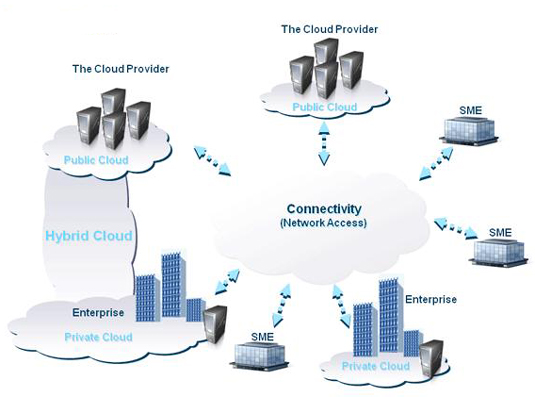
In terms of the types of Cloud that can be deployed, again something that probably most people in the room are aware of. There are four broad types there is the private Cloud which is often seen as an extension of the existing on-premise solution. It’s a single tenant solution. It’s, in terms of security and privacy and so on, its viewed as being a little bit more secure and private than other variations of the Cloud, so perhaps a safe bet for organisations and government departments that are concerned about those aspects in particular

Public Cloud’s are more open, typically shared access to infrastructure, shared infrastructure [if you] get economies of scale coming in there, typically managed and owed by the provider rather than by the entity deploying services into the Cloud. And this is often used by SMEs and start-ups as a way to lower the entry costs for them coming into business. 

Typically not at the moment something that governments are particularly focusing on for some of the more secure and privacy focused data and information that have, but something that governments are actually quite interested in, in terms of economies and scale and the flexibility that, that gives them. 

The next one is community Cloud’s which is a sort of extended private Cloud where it serves multiple users with very similar requirements and needs. And often you actually find that governments and government agencies fall into this category and often find community Cloud’s quite interesting, because it gives them an extension of a private Cloud, greater economies of scale without perhaps some of the security concerns that crop up in a public Cloud

And then finally hybrid Cloud’s where you have a mix of private and the public Clouds, save for the private cloud used for a lot of internal systems and public Cloud perhaps used for [off-site] back up and so on. So drilling into some actual specific examples of what governments have been doing around moving services to the Cloud, and also their own infrastructure into the Cloud. 

The US has been very forceful in their stated intent to move services into the Cloud, government services into the Cloud. And the CIO recent Federal Cloud Computing Strategy it was published around January or February of this year, specifically stated that there would be a Cloud burst approach for government departments from that point on, so they would look to deploy applications and services into the Cloud rather than on dedicated infrastructure. 

And they’ve also provided a range of case studies of existing departments and agencies that have deployed services into the Cloud that other agencies can look at to learn from the challenges that they faced and the approaches that they’ve adopted to overcome those challenges. And within that Cloud computing strategy they set out a decision framework for how to migrate services into the Cloud, to make sure that those services are migrated smoothly and efficiently and for the best benefit in terms of cost and service level for the citizens and also for the government departments. 

It’s a three stage process, the first stage is to select which services are to be migrated, looking at Cloud readiness and Cloud that takes into account whether those services are ready to be migrated to the Cloud in terms of interoperability, availability of suitable Cloud-based applications and so on, and the value that will be gained in migrating those services to the Cloud in terms of cost savings or additional services for citizens and so on. 

And then it goes through the different stages of then provisioning those services and then managing those services. And as well as the US there are a number of other markets that are looking at similarly migrating a lot of government infrastructure and government services into the Cloud, and offering e-Government services that way. 

There are some examples up here, it’s certainly not an exhaustive list, a quick search on Google and around a few government websites will yield a few more hits. The UK has got a very clear statement again around using the public Cloud first with a private government Cloud in place for government services that aren’t suited to the public Cloud. And their also undergoing a consolidation of government-owned data centres to bring that all into one common data centre rather than having fragmentation there to reduce costs and to save costs there. 

That’s quite similar to the approach the Singapore Government is using. Again, they’ve stated their going to use public Cloud if appropriate with a whole of government private [G] Cloud available where security and governance needs imply that public Cloud is not the place to put those services. And they also actually allow the individual agencies to deploy and operate their own private Clouds, but can interoperate with this whole of government G Cloud. 

Again, if there are security and governance concerns that mean that, that particular agency would like their own private Cloud rather than using a shared Cloud. So the private G Cloud in Singapore is very similar to the community Cloud that I mentioned earlier, it’s a shared Cloud across government departments to use.

We also have examples in Japan of across-department collaboration in a nation-wide cross-department collaboration, and interoperability among local governments collaboration for the Cloud as well, so their very keen on Cloud deployment, deployment of e-Gov services. 

India’s unique identification initiative is going to be deployed in the Cloud to address some of the computing and processing challenges that they see emerging from that. And similarly the European Commission in Thailand have looked at moving quite a few services into the Cloud to save costs and improve interaction with citizens. 

Just pulling down into some of the challenges that the different governments and different agencies see, there was a survey carried out, again started this year by InformationWeek India. I don’t know if we’ve got anybody in the room from that magazine, but if we do then thank you very much for this information. 

The main concern raised by the public sector in terms of Cloud computing challenges is very much around security of systems and data, so something that fits very well with the discussion this morning around there are loss of — the perceived loss of control of that data if it moves into a Cloud-based infrastructure, how they ensure that, that information is secure, how they ensure that people can’t get access that shouldn’t have access to it and so on. 

And you see a very rapid drop down the different challenges that are seen there by the public sector. Again the compatibility with legacy applications and processes is raised as an issue. And then you’re into more cultural resistance within the IT department, perhaps looking to protect some of the jobs there as well, going into lack of expertise and experience all the way down to the difficulty that is seen, again within enterprises and government, around actually establishing a business case for the Cloud migration. 

So in terms of overcoming some of those challenges, not looking into great detail on the technical side of things, in some ways that is an issue for the vendors to address,we’ve had some good presentations this morning on that, and I’m sure there will be more discussion on that in the rest of the sessions. 

In terms of the security and governance and privacy of the data one option is to use private Clouds in the short term or where there are concerns over putting information into the public Cloud. That is something that as I said earlier that Singapore and the UK are very happy to have happen. 

Obviously that doesn’t generate the same cost savings and benefits to the government that using the public Cloud [across] all services would generate. But there is the challenge about security and privacy that they having to address there. Vendors will have to be very closely involved. 

This is much more of a partnership approach than a hands off approach that governments often used to take. Appropriate SLAs need to be put into place. And very importantly it’s essential that governments work with development legal authorities and regulators to identify any potential any legal loopholes about storing data outside of the country, outside of government premises and so on, and to close those loopholes, perhaps taking reference from some more mature markets such as the financial markets and so on. And then on the interoperability side helping to overcome the challenges of interoperability, this was addressed in the Cloud Computing Strategy from the US Government. 

Looking at identifying services that are ready to be moved to the Cloud with little additional work, and taking a stepped and phased approach there rather than going too fast, too soon. And also working again closely with vendors to make sure legacy support with the applications are already deployed within the Government. And finally it’s about sharing best practice and information on what’s been done elsewhere. What’s been successful, what hasn’t been successful? 

What challenges have been faced, and how those challenges have been overcome? And then finally just moving onto the issue that is quite pressing in a lot of the emerging markets across the globe in Asia-Pacific, in South America, in Africa and so on, is around about the availability of suitable infrastructure to enable services to be moved into the Cloud and still be accessed on a consistent and reactive basis by the departments that are looking to use those services. 

A lot of governments are looking at deploying new networks or addressing issues with fixed line infrastructure and broadband infrastructure in markets through national broadband plans. One of the tenants that goes into that is actually around the government being a leading user of broadband services and of infrastructure. And the Cloud can actually enable that by the government taking a leading role and putting a guaranteed spend or revenue in with providers of a new network. 

It doesn’t address the issue completely because you have the challenge being faced between using fixed line networks, some access to the Cloud and wireless networks for other access to the Cloud. And that’s one challenge that I think a lot of application providers and vendors will have to address about the different latency issues and the different throughput issues. And that’s something that the government can certainly take a leading role in, by deploying their services into the Cloud and demonstrating to enterprise in the private sector that there is an opportunity there for migration of services and infrastructure. 

So, just to wrap up, governments as is the case of enterprises see Cloud Computing as a way to lower costs, as a way to improve services and as a way to in a Big Brother style, gain greater insight into citizens. However, there are a range of decisions and challenges to be faced in making that migration around the choice of deployment model. 

Whether to use private Cloud, public Cloud, hybrid Cloud or community Cloud, which services to migrate and when, and the challenges that are going to be faced around, again, the security side of things, data ownership, governance and so on. Interoperability with existing applications and across departments and around the availability of infrastructure to deliver those services and to move that information into data centres and so on

Collaboration amongst government departments, perhaps even across nations, to share best practice and to share challenges and approaches to overcome those challenges, and collaboration with vendors is key to achieving the end game, the end results that governments are looking for. And Cloud Computing itself can be seen to spur advances in infrastructure to encourage both the adoption and take-up of these services and of broadband infrastructure across emerging markets, perhaps creating a more virtuous circle for the rollout of high-speed services, lower latency services and so on. 

http://cloudcomputingnews.in

Rabu, 09 November 2011

Government Clouds: Are People Ready?

Andrea Di Maio
VP Distinguished Analyst Gartner
This morning, at the Gartner Symposium in Barcelona, I ran a Net IT Out session on cloud computing in government. This was meant to be a rapid fire session where an analyst briefly introduces a subject and some of the Gartner’s positions, and then leaves as much time as possible to a Q&A. The room was so packed that we had to arrange for overflow attendance outside the room, through a videolink, and the possibility for people to pose questions via Twitter. So the level of interest looked very high.  
However as I got into the Q&A session, nobody would dare asking the first one. When I then polled the audience (in the room) to know how many of them had cloud deployments in place, very few raised their hands. When questions started to come, I found that – albeit intesting and useful – they were not too dissimilar from I could have heard a year ago.

The only slight variation seems to be a greater interest and concern for the procurement side of things as opposed to “implementing” clouds, but this could be due to the spin of my introduction, where I put quite some emphasis on the importance of the former rather than the latter aspect.

There were a few interesting questions about to perform due diligence for cloud services, which also tied nicely into the procurement discussion. However the was hardly the number of questions and level of activity I would expected given how important cloud computing seems to be from most of our survey work and from the huge attendance.

After the session I had a few more exchanges about the link between the constraint of data sovereignty and the level of investment that vendors are (or are rather not) making into specific jurisdictions. My take that – given the slow market uptake – most vendors will first focus on leveraging their existing, mostly US-based infrastructure, before serving public sector needs in other countries seemed to be confirmed.

All in all, it seems to me that, while cloud computing will definitely have an impact and possibly become the primary sourcing model for many government organizations, the transition will be far slower than many think, or hope for, and certainly so in Europe.
http://blogs.gartner.com

Corruption Perceptions Index 2018

Why China is building islands in the South China Sea

INDONESIA NEW CAPITAL CITY

World Economic Forum : Smart Grids Explained

Berita Terbaru


Get Widget